
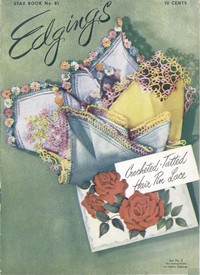
Edgings: crocheted, tatted, hair pin lace
Written by American Thread Company
Chaptra reads alongside you — AI insights, chapter breakdowns and reader discussions for every book. Join free
About this book
Read it with a club
Small groups reading the same books and talking as they go.


News
- 4 members
- 1,813 discussions
- Active Sep 11
Read Edgings: crocheted, tatted, hair pin lace alongside people who are reading it too.
Also here: News Bulletin, Just Joking....
Chaptra Prime — paid clubs, every club feature, and unlimited reading support, for $5 a month or $60 once.
See PrimeReading guide
Themes, characters and key ideas in Edgings: crocheted, tatted, hair pin lace, written by Chaptra AI.
- about 30 hours
- intermediate
- instructive
- creative
- detailed
"Edgings: crocheted, tatted, hair pin lace" is a pivotal craft manual from the early 1950s by the American Thread Company, meticulously detailing various lace-making techniques. It serves as a comprehensive guide, primarily focusing on crocheting and tatting, with a special section on hairpin lace, designed to empower home crafters. The book systematically presents illustrated instructions for creating decorative edgings, suitable for common household items like handkerchiefs and towels, emphasizing both aesthetic appeal and practical application. Through its step-by-step approach, material lists, and design tips, it not only teaches intricate patterns but also preserves traditional textile arts within the post-war domestic sphere.
“"Follow each step carefully to ensure the perfect finish."”
Key themes
- Domesticity and Homemaking
- The manual strongly reinforces the cultural importance of domesticity in the post-WWII era, where homemaking was a central female role. By providing instructions for decorative items for the home (handkerchiefs, towels), it positions crafting as an integral part of creating a beautiful and well-kept domestic environment. It suggests that personal effort and skill contribute significantly to the comfort and aesthetic appeal of the home.
- Skill Preservation and Heritage
- The manual plays a crucial role in the preservation and transmission of traditional textile arts, specifically crocheting, tatting, and hairpin lace. By meticulously documenting these techniques and patterns, it ensures that knowledge passed down through generations continues to be accessible and practiced. It connects the contemporary crafter to a rich heritage of needlework, emphasizing the value of learned skills and craftsmanship.
- Creativity and Self-Expression
- Beyond mere instruction, the manual implicitly encourages individual creativity and self-expression through the mastery of craft. By offering a variety of patterns and techniques, it empowers the crafter to choose, adapt, and personalize designs, transforming raw materials into unique works of art. The act of creation itself provides a fulfilling outlet for personal ingenuity and aesthetic taste.
Worth discussing
How does a craft manual, like this one, reflect the cultural values and domestic ideals of its time (early 1950s)?
Chapter-by-chapter breakdowns, character arcs and the full thematic analysis come with a free account.
Discussions
No one has started one yet
Questions this book opens up
No discussions yet
Be the first to start a discussion about this book!
Sign up to start the discussionReviews
No reviews yet
Be the first to review this book!