
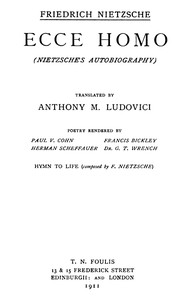
Ecce Homo: Complete Works, Volume Seventeen
Written by Friedrich Wilhelm Nietzsche
Chaptra reads alongside you — AI insights, chapter breakdowns and reader discussions for every book. Join free
About this book
Read it with a club
Small groups reading the same books and talking as they go.


News
- 4 members
- 1,813 discussions
- Active Sep 11
Read Ecce Homo: Complete Works, Volume Seventeen alongside people who are reading it too.
Also here: News Bulletin, Just Joking....
Chaptra Prime — paid clubs, every club feature, and unlimited reading support, for $5 a month or $60 once.
See PrimeReading guide
Themes, characters and key ideas in Ecce Homo: Complete Works, Volume Seventeen, written by Chaptra AI.
- about 15 hours
- advanced
- Provocative
- Introspective
- Polemical
Ecce Homo is Friedrich Nietzsche's highly unconventional and provocative autobiography, written shortly before his mental collapse. In this work, Nietzsche attempts to explain his life and works, clarifying his philosophical contributions and defending himself against perceived misunderstandings. He presents himself as a revolutionary thinker, a "destiny" who has revalued all values, and offers a radical self-interpretation, detailing "Why I Am So Wise," "Why I Am So Clever," "Why I Write Such Good Books," and "Why I Am a Destiny." It serves as a defiant self-justification and a final, passionate articulation of his core philosophical tenets from his own perspective.
“I am no man, I am dynamite.”
Key themes
- Revaluation of All Values
- This is the overarching theme of Nietzsche's entire philosophical project and is central to Ecce Homo. He portrays himself as the individual destined to overturn millennia of Western moral and intellectual traditions, particularly those stemming from Christianity and Socratic rationalism. He argues that existing values are life-denying and based on ressentiment, advocating for a radical re-evaluation that prioritizes strength, creativity, and affirmation of life.
- The Will to Power and Self-Overcoming
- Nietzsche explains his concept of the 'will to power' not as brute domination, but as an inherent drive in all living things to grow, overcome resistance, and assert themselves. He presents his own life, particularly his struggles with illness and solitude, as an example of self-overcoming – the process of constantly challenging and transcending one's limitations to achieve a higher state of being. This theme is deeply personal and autobiographical in Ecce Homo.
- Critique of Morality and Religion
- Nietzsche uses Ecce Homo to reiterate and elaborate on his profound critique of traditional Christian morality and the philosophical systems that uphold it. He argues that these systems are based on weakness, fear, and a 'will to nothingness,' actively suppressing human vitality and creative potential. He positions himself as the 'Anti-Christ,' not necessarily in a literal sense, but as the philosophical antithesis to these life-denying values.
Worth discussing
How does Nietzsche's self-portrayal in Ecce Homo influence or alter your understanding of his philosophical ideas?
Chapter-by-chapter breakdowns, character arcs and the full thematic analysis come with a free account.
Discussions
No one has started one yet
Questions this book opens up
No discussions yet
Be the first to start a discussion about this book!
Sign up to start the discussionReviews
No reviews yet
Be the first to review this book!