
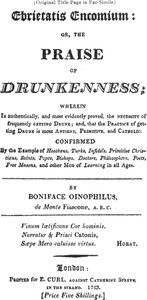
Ebrietatis Encomium: or, the Praise of Drunkenness
Written by Albert-Henri de Sallengre
Chaptra reads alongside you — AI insights, chapter breakdowns and reader discussions for every book. Join free
About this book
Reading guide
Themes, characters and key ideas in Ebrietatis Encomium: or, the Praise of Drunkenness, written by Chaptra AI.
- about 8 hours
- advanced
- humorous
- satirical
- witty
Albert-Henri de Sallengre's "Ebrietatis Encomium" is an early 18th-century satirical treatise that ingeniously argues for the virtues and necessities of drunkenness. Far from a moral condemnation, the work adopts a witty and provocative stance, presenting intoxication as a means to alleviate sorrow, foster social harmony, and even promote health. Sallengre masterfully employs historical, philosophical, and cultural allusions, citing figures from ancient sages to revered churchmen, to bolster his unconventional defense. Through a blend of humor and scholarly pretense, the author challenges conventional austere views on sobriety, positioning drunkenness as an inherent and often beneficial aspect of the human condition, worthy of serious, albeit ironic, commendation.
“It is not my design here to write a panegyric on drunkenness, but only to defend it from the unjust reproaches usually cast upon it.”
Key themes
- Satire and Subversion of Morality
- The core of the work lies in its satirical inversion of moral values. Sallengre takes a commonly condemned vice, drunkenness, and systematically argues for its virtues, thereby mocking the rigidity of conventional morality and exposing the often arbitrary nature of social judgments. This theme challenges readers to question what truly constitutes 'good' or 'bad' behavior and the authority of those who define it.
- Rhetoric and Persuasion
- Sallengre's treatise is a masterclass in rhetorical strategy. The theme explores how arguments are constructed, how evidence (even selective or dubious evidence) is employed, and how an author can persuade an audience to consider an unconventional viewpoint. It highlights the power of language and intellectual dexterity to shape perception, regardless of the inherent 'truth' of the subject matter.
- Human Psychology: Escapism and Conviviality
- Beyond the satire, the treatise touches upon genuine human needs for escapism from sorrow and the desire for social connection. Sallengre's arguments, while ironic, resonate with the real-world functions that alcohol (and other forms of altered consciousness) have historically served in human societies. It implicitly explores the psychological comfort derived from forgetting troubles and the social bonding fostered by shared experiences of intoxication.
Worth discussing
How does Sallengre's use of satire challenge conventional moral views on 'vice' and 'virtue'?
Chapter-by-chapter breakdowns, character arcs and the full thematic analysis come with a free account.
Discussions
No one has started one yet
Questions this book opens up
No discussions yet
Be the first to start a discussion about this book!
Sign up to start the discussionReviews
No reviews yet
Be the first to review this book!