
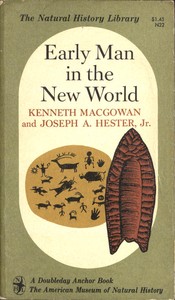
Early Man in the New World
Written by Joseph A. Hester,Kenneth Macgowan
Chaptra reads alongside you — AI insights, chapter breakdowns and reader discussions for every book. Join free
About this book
Reading guide
Themes, characters and key ideas in Early Man in the New World, written by Chaptra AI.
- about 8 hours
- advanced
- informative
- scholarly
- analytical
Kenneth Macgowan and Joseph A. Hester's "Early Man in the New World" is a seminal mid-20th-century scientific exploration into the origins and ancient history of human populations across the Americas. The book meticulously synthesizes archaeological findings, anthropological theories, and emerging scientific methodologies to trace the migration of early peoples from Asia into North America. It illuminates the complex processes by which these initial inhabitants established diverse cultures, adapted to varied environments, and developed sophisticated societies over millennia. The authors emphasize the evolving nature of scientific understanding, challenging previous assumptions and advocating for a nuanced, evidence-based approach to understanding pre-Columbian America. Ultimately, it serves as a foundational text detailing the journey of discovery surrounding the first Americans.
“The story of early man in the New World is not a simple narrative but a complex tapestry woven from fragments of bone, stone, and the silent testimony of ancient earth.”
Key themes
- Human Migration and Origins
- This theme explores the central question of how and when humans first arrived in the Americas. The book meticulously details the prevailing Beringia land bridge theory, outlining the proposed routes, timing, and conditions that facilitated the migration from Asia. It synthesizes archaeological evidence to trace the initial movements and subsequent dispersal across the continents, establishing a foundational understanding of the peopling of the New World.
- Adaptation and Cultural Development
- This theme focuses on the remarkable ability of early human populations to adapt to vastly diverse environments across the Americas, from arctic tundras to arid deserts and tropical rainforests. It examines the development of varied subsistence strategies, tool technologies, social structures, and cultural practices that allowed these groups to not only survive but thrive and establish complex societies over millennia. The book highlights the ingenuity and resilience inherent in human communities.
- The Nature of Scientific Inquiry and Progress
- A significant underlying theme is the dynamic and often challenging process of scientific discovery itself. The authors reflect on the evolution of theories, the limitations of previous understandings, and the transformative impact of new methodologies like radiocarbon dating. It underscores that scientific knowledge is not static but constantly refined and sometimes overturned by new evidence, emphasizing the importance of critical thinking, interdisciplinary collaboration, and an open mind in archaeological and anthropological research.
Worth discussing
How has the understanding of early human migration to the Americas evolved since the mid-20th century, and what new evidence has contributed to these changes?
Chapter-by-chapter breakdowns, character arcs and the full thematic analysis come with a free account.
Discussions
No one has started one yet
Questions this book opens up
No discussions yet
Be the first to start a discussion about this book!
Sign up to start the discussionReviews
No reviews yet
Be the first to review this book!