
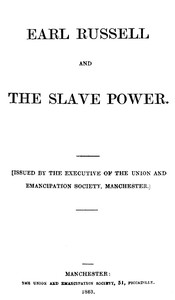
Earl Russell and the Slave Power
Written by England) Union and Emancipation Society (Manchester
Chaptra reads alongside you — AI insights, chapter breakdowns and reader discussions for every book. Join free
About this book
Reading guide
Themes, characters and key ideas in Earl Russell and the Slave Power, written by Chaptra AI.
- about 2 hours
- advanced
- persuasive
- didactic
- urgent
Earl Russell and the Slave Power is a critical pamphlet published by the Union and Emancipation Society of Manchester, England, during the American Civil War. The document vehemently argues against the perceived neutrality or pro-Confederate leanings of Lord John Russell, then British Foreign Secretary, by exposing the moral bankruptcy of the Confederacy's foundation on slavery. It aims to sway British public opinion and government policy towards active support for the Union, emphasizing the moral imperative to oppose the 'Slave Power' and uphold democratic principles. The society frames the conflict not merely as a political struggle but as a clash between freedom and oppression, urging Britain to align itself with the cause of emancipation.
“"To stand neutral in such a contest is to be an accomplice with the oppressor."”
Key themes
- Abolitionism and Moral Imperative
- This is the central theme, arguing that the American Civil War is fundamentally a moral struggle against the institution of slavery. The pamphlet insists that Britain has a moral obligation to oppose slavery unequivocally, irrespective of economic interests or diplomatic conveniences. It champions the cause of human freedom as a universal principle that transcends national borders.
- International Diplomacy and National Interest vs. Morality
- The pamphlet critically examines the tension between Britain's perceived national interests (e.g., access to Confederate cotton, avoiding war) and its moral standing on slavery. It argues that prioritizing economic or political expediency over moral principles is a grave error and ultimately detrimental to Britain's long-term reputation and influence. It challenges the notion that foreign policy should be devoid of ethical considerations.
- Democracy vs. Oligarchy (Slaveocracy)
- The pamphlet implicitly and explicitly frames the American Civil War as a battle for the future of democratic governance. It contrasts the democratic ideals of the Union with the aristocratic, slave-owning oligarchy of the Confederacy, warning that supporting the latter would undermine democratic principles globally. It appeals to the democratic sentiments within British society.
Worth discussing
How did British public opinion on the American Civil War evolve, and what role did pamphlets like this play?
Chapter-by-chapter breakdowns, character arcs and the full thematic analysis come with a free account.
Discussions
No one has started one yet
Questions this book opens up
No discussions yet
Be the first to start a discussion about this book!
Sign up to start the discussionReviews
No reviews yet
Be the first to review this book!