
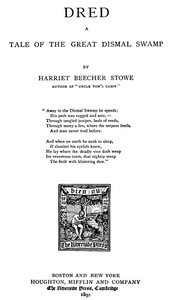
Dred: A Tale of the Great Dismal Swamp
Written by Harriet Beecher Stowe
Chaptra reads alongside you — AI insights, chapter breakdowns and reader discussions for every book. Join free
About this book
Reading guide
Themes, characters and key ideas in Dred: A Tale of the Great Dismal Swamp, written by Chaptra AI.
- about 12 hours
- advanced
- somber
- didactic
- tense
“Dred: A Tale of the Great Dismal Swamp” is Harriet Beecher Stowe's powerful follow-up to *Uncle Tom's Cabin*, offering a more intense and complex exploration of slavery's systemic evils in the antebellum American South. The novel intertwines the narratives of Nina Gordon, a spirited but morally conflicted Southern heiress, and Edward Clayton, an idealistic lawyer striving for justice within a corrupt legal system. Their paths converge with Dred, an enigmatic maroon prophet inspired by Nat Turner, who leads a community of runaway slaves in the Great Dismal Swamp and embodies the spirit of righteous resistance. Stowe meticulously exposes the legal intricacies, social hypocrisies, and profound human cost of slavery, delving into themes of morality, religion, freedom, and the explosive potential for rebellion, ultimately arguing for the imperative of abolition.
“"The greatest curse of slavery is its moral influence, corrupting the very fountains of justice and humanity."”
Key themes
- Slavery's Injustice and Dehumanization
- This is the central theme of the novel, explored through explicit descriptions of physical and emotional abuse, the breaking up of families, and the denial of basic human rights. Stowe meticulously details the legal framework that supported slavery, demonstrating how it stripped individuals of their humanity and corrupted society.
- Moral Responsibility and Conscience
- Stowe examines the individual's moral obligation in the face of injustice. Nina Gordon's transformation from a self-absorbed heiress to an abolitionist highlights the awakening of conscience, while Edward Clayton embodies the struggle of maintaining moral integrity within a corrupt system. The novel challenges readers to confront their own complicity, passive or active, in perpetuating injustice.
- Religion and Spirituality
- Religion plays a multifaceted role, serving both as a justification for slavery by some (e.g., 'curse of Ham' interpretations) and as a powerful source of liberation and resistance for others. Dred, in particular, embodies a fiery, Old Testament prophetic spirituality that calls for divine retribution against oppressors, contrasting with the more conventional, often hypocritical, Christianity of the white South.
Worth discussing
How does Stowe's portrayal of Dred differ from or build upon her depiction of enslaved characters in *Uncle Tom's Cabin*? What is the significance of his character as a figure of resistance?
Chapter-by-chapter breakdowns, character arcs and the full thematic analysis come with a free account.
Discussions
No one has started one yet
Questions this book opens up
No discussions yet
Be the first to start a discussion about this book!
Sign up to start the discussionReviews
No reviews yet
Be the first to review this book!