
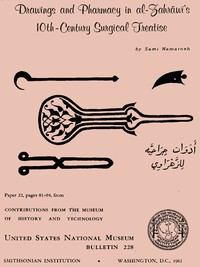
Drawings and Pharmacy in Al-Zahrawi's 10th-Century Surgical Treatise
Written by Sami Khalaf Hamarneh
Chaptra reads alongside you — AI insights, chapter breakdowns and reader discussions for every book. Join free
About this book
Reading guide
Themes, characters and key ideas in Drawings and Pharmacy in Al-Zahrawi's 10th-Century Surgical Treatise, written by Chaptra AI.
- about 6 hours
- advanced
- academic
- informative
- historical
Sami Hamarneh's "Drawings and Pharmacy in Al-Zahrawi's 10th-Century Surgical Treatise" is a foundational scholarly work from the early 1960s, published by the Smithsonian Institution, that meticulously examines the groundbreaking surgical contributions of Abū al-Qāsim al-Zahrāwī. The publication delves into al-Tasrīf, al-Zahrāwī's comprehensive 10th-century treatise, with a particular focus on its innovative illustrations of surgical instruments and medicinal preparations. Hamarneh employs a comparative analysis of original Arabic drawings against later Latin and vernacular translations, elucidating their instructional significance for surgical apprentices. Ultimately, the book underscores al-Zahrāwī's profound influence on the evolution of surgical techniques and pharmacological practices in both Islamic and Western medical traditions.
“Al-Zahrawi's treatise, al-Tasrif, stands as a testament to the sophisticated understanding of surgery and pharmacology in 10th-century Arabic Spain.”
Key themes
- The Transmission of Medical Knowledge
- This theme is central to Hamarneh's analysis, exploring how al-Zahrāwī's surgical knowledge, particularly his innovative illustrations, was disseminated from Arabic Spain to the broader Islamic world and subsequently to Latin Europe. Hamarneh's comparative study of original Arabic drawings and later translations directly addresses the fidelity, adaptation, and impact of this cross-cultural transmission, highlighting the mechanisms through which ancient and medieval medical practices evolved and spread.
- Innovation in Medieval Surgery and Pedagogy
- Hamarneh emphasizes al-Zahrāwī's pioneering contributions to surgical techniques and, crucially, to the pedagogical methods used to teach surgery. The book highlights how al-Zahrāwī's detailed textual descriptions, combined with his unique and comprehensive illustrations, constituted a revolutionary approach to medical education. This theme celebrates the ingenuity of medieval practitioners in developing both practical medical solutions and effective instructional tools.
- The Holistic Nature of Medieval Medicine
- Hamarneh's analysis reveals that al-Zahrāwī's surgical treatise was not narrowly focused on surgical procedures alone but integrated pharmacological preparations as an essential component of patient care. This demonstrates a holistic understanding of medicine, where surgery, pharmacy, and general medical knowledge were interconnected. The theme highlights a comprehensive approach that contrasts with later, more specialized divisions within medicine.
Worth discussing
How did al-Zahrāwī's use of illustrations revolutionize medical education in the 10th century, and what parallels can be drawn to modern medical training?
Chapter-by-chapter breakdowns, character arcs and the full thematic analysis come with a free account.
Discussions
No one has started one yet
Questions this book opens up
No discussions yet
Be the first to start a discussion about this book!
Sign up to start the discussionReviews
No reviews yet
Be the first to review this book!