
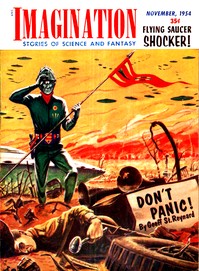
Don't Panic!
Written by Robert W. Krepps
Chaptra reads alongside you — AI insights, chapter breakdowns and reader discussions for every book. Join free
About this book
Reading guide
Themes, characters and key ideas in Don't Panic!, written by Chaptra AI.
- about 8 hours
- intermediate
- Tense
- Apocalyptic
- Fearful
Set in the mid-20th century, Robert W. Krepps' "Don't Panic!" chronicles an unexpected alien invasion by enigmatic extraterrestrial beings known as the Green Men, who land on Earth on January 9, 1955. The story immediately plunges humanity into widespread panic and chaos, particularly in Washington, D.C., as government agencies grapple with the reality of confirmed alien life. Amidst the societal breakdown and public hysteria, protagonist Sergeant Trace Roscoe emerges, battling personal disbelief and fear while witnessing civilization teeter on the brink. The narrative explores initial encounters, the fearful human response, and the first desperate clashes for survival against an overwhelming, incomprehensible alien force.
“"The sky was no longer merely a backdrop; it was a canvas for our doom."”
Key themes
- Fear and Hysteria
- The novel vividly portrays the immediate and overwhelming societal response of fear and mass hysteria following the alien invasion. It explores how panic can cripple rational thought, undermine social order, and become as destructive a force as the invaders themselves, highlighting the fragility of human composure under extreme stress.
- Human Resilience and Survival
- In contrast to the pervasive panic, the novel also champions the indomitable spirit of human resilience. It focuses on characters like Sergeant Roscoe who, despite overwhelming odds and profound despair, find the strength to adapt, fight back, and cling to the hope of survival, showcasing humanity's capacity for courage and endurance.
- Societal Breakdown
- The narrative meticulously details the rapid unraveling of established social structures and order in the face of an overwhelming crisis. It examines how institutions, governance, and the rule of law can quickly collapse when confronted with an existential threat, giving way to chaos, self-preservation, and a struggle for basic survival.
Worth discussing
How does 'Don't Panic!' reflect the Cold War anxieties and societal fears prevalent in the 1950s?
Chapter-by-chapter breakdowns, character arcs and the full thematic analysis come with a free account.
Discussions
No one has started one yet
Questions this book opens up
No discussions yet
Be the first to start a discussion about this book!
Sign up to start the discussionReviews
No reviews yet
Be the first to review this book!