
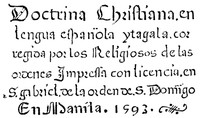
Doctrina Christiana: The first book printed in the Philippines, Manila, 1593.
Written by Unknown author
Chaptra reads alongside you — AI insights, chapter breakdowns and reader discussions for every book. Join free
About this book
Read it with a club
Small groups reading the same books and talking as they go.


News
- 4 members
- 1,813 discussions
- Active Sep 11
Read Doctrina Christiana: The first book printed in the Philippines, Manila, 1593. alongside people who are reading it too.
Also here: News Bulletin, Just Joking....
Chaptra Prime — paid clubs, every club feature, and unlimited reading support, for $5 a month or $60 once.
See PrimeReading guide
Themes, characters and key ideas in Doctrina Christiana: The first book printed in the Philippines, Manila, 1593., written by Chaptra AI.
- about 12 hours
- intermediate
- Didactic
- Reverent
- Instructive
The 'Doctrina Christiana' is a foundational religious catechism, notable as the first book ever printed in the Philippines in 1593. Commissioned by the Spanish Dominicans and printed using xylography, it served as a primary tool for evangelization, introducing the basic tenets of Catholicism to the indigenous Filipinos. The book features parallel texts in Spanish and Tagalog (both in Latin script and Baybayin, the pre-colonial syllabary), making it an invaluable linguistic artifact. Its content covers essential prayers, the Ten Commandments, sacraments, and the articles of faith, aimed at facilitating widespread conversion and instruction during the early colonial period.
“Pater Noster, qui es in cælis, sanctificetur nomen Tuum: adueniat regnum Tuum: fiat voluntas Tua, sicut in cælo, & in terra.”
Key themes
- Evangelization and Religious Conversion
- The central and explicit purpose of the 'Doctrina Christiana' was to propagate Catholic faith among the indigenous population of the Philippines. It systematically laid out the fundamental tenets of Christianity, including prayers, commandments, and sacraments, in an accessible format to facilitate widespread conversion and instruction. This theme is explored through the direct presentation of doctrine.
- Colonialism and Cultural Assimilation
- The book is a product of Spanish colonialism, serving as a primary instrument for the cultural and spiritual assimilation of the Filipinos. Its creation and dissemination were integral to the Spanish strategy of establishing control by instilling Spanish religious and moral values, effectively replacing or integrating pre-colonial belief systems and social structures. The very act of printing and distributing such a text signifies the imposition of foreign authority and worldview.
- Linguistic Preservation and Development
- Despite its colonial origins, the 'Doctrina Christiana' is a vital artifact for the study of the Tagalog language. Its bilingual format, specifically the inclusion of Tagalog text in both Latin script and the native Baybayin syllabary, provides invaluable insights into the phonology, morphology, and vocabulary of 16th-century Tagalog. It documents an early stage of the language's interaction with Spanish and the transition from pre-colonial writing systems to the Latin alphabet, influencing future linguistic standardization.
Worth discussing
Discuss the historical significance of 'Doctrina Christiana' as the first book printed in the Philippines. What does its existence tell us about the early Spanish colonial project?
Chapter-by-chapter breakdowns, character arcs and the full thematic analysis come with a free account.
Discussions
No one has started one yet
Questions this book opens up
No discussions yet
Be the first to start a discussion about this book!
Sign up to start the discussionReviews
No reviews yet
Be the first to review this book!