
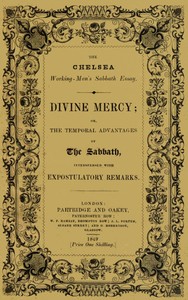
Divine Mercy; or, the temporal advantages of the Sabbath
Written by George Bryan
Chaptra reads alongside you — AI insights, chapter breakdowns and reader discussions for every book. Join free
About this book
Reading guide
Themes, characters and key ideas in Divine Mercy; or, the temporal advantages of the Sabbath, written by Chaptra AI.
- about 8 hours
- intermediate
- serious
- didactic
- earnest
George Bryan's mid-19th century essay, "Divine Mercy; or, the temporal advantages of the Sabbath," is a fervent argument for the preservation and observance of the Sabbath, particularly emphasizing its practical benefits for the working classes. Set against the backdrop of Victorian industrialization, Bryan posits that regular rest from labor is not merely a religious obligation but a crucial component for physical health, moral integrity, and societal harmony. He meticulously details how unceasing toil leads to physical deterioration, moral decay, and the breakdown of family units, advocating for the Sabbath as a necessary respite that allows for spiritual reflection, familial bonding, and overall societal progress. The work serves as both a theological plea and a piece of social commentary, urging a return to respecting the Sabbath for human dignity and well-being.
“The Sabbath is not merely a day of religious observance, but a divine provision for the temporal well-being of man, essential for his health, morality, and social harmony.”
Key themes
- The Sanctity and Utility of the Sabbath
- This is the central theme of the essay, arguing that the Sabbath is both a divinely ordained day of rest and a profoundly beneficial institution for human well-being. Bryan explores its religious origins while emphasizing its practical, 'temporal' advantages for individuals and society, bridging the gap between spiritual duty and material benefit.
- Social Justice and Labor Rights
- Though not explicitly a labor rights treatise, the essay implicitly advocates for better working conditions and the right to rest, particularly for the working classes. Bryan highlights the exploitation inherent in continuous labor and frames the Sabbath as a necessary protection against the dehumanizing aspects of industrialization, thereby touching upon themes of social justice.
- Moral and Spiritual Well-being
- Bryan strongly links the observance of the Sabbath to the cultivation of moral character and spiritual growth. He argues that without dedicated time for reflection, religious instruction, and family bonding, individuals, especially the poor, are more susceptible to vice and moral decay. The Sabbath is presented as a preventative measure against societal ills.
Worth discussing
To what extent are Bryan's arguments for the 'temporal advantages' of the Sabbath still relevant in contemporary society regarding work-life balance and mental health?
Chapter-by-chapter breakdowns, character arcs and the full thematic analysis come with a free account.
Discussions
No one has started one yet
Questions this book opens up
No discussions yet
Be the first to start a discussion about this book!
Sign up to start the discussionReviews
No reviews yet
Be the first to review this book!