
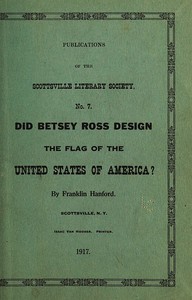
Did Betsey Ross Design the Flag of the United States of America?: Publication of the Scottsville Literary Society
Written by Franklin Hanford
Chaptra reads alongside you — AI insights, chapter breakdowns and reader discussions for every book. Join free
About this book
Reading guide
Themes, characters and key ideas in Did Betsey Ross Design the Flag of the United States of America?: Publication of the Scottsville Literary Society, written by Chaptra AI.
- about 3 hours
- advanced
- historical
- analytical
- skeptical
Franklin Hanford's "Did Betsey Ross Design the Flag of the United States of America?" is an early 20th-century historical inquiry that meticulously dissects the popular legend attributing the design of the American flag to Betsey Ross. The author embarks on a critical examination of historical records, anecdotal accounts, and biographical details surrounding Ross, scrutinizing the claims that she crafted the first Stars and Stripes following a visit from George Washington. Hanford concludes that while Ross was a skilled seamstress involved in flag production, there is no definitive historical proof to substantiate her role as the flag's designer or original creator. The book ultimately asserts that the narrative surrounding Ross is more a product of folklore than verifiable fact, leaving the true origins of the flag ambiguous and emphasizing the importance of historical rigor over popular myth.
“"The popular narrative, however cherished, often finds itself at odds with the unyielding scrutiny of historical evidence."”
Key themes
- Historical Revisionism and Myth-busting
- This is the central theme, as Hanford's entire project is dedicated to re-examining and challenging a popular, yet historically unsubstantiated, national myth. The book exemplifies the process of historical revisionism, where established narratives are critically re-evaluated based on new evidence or a more rigorous application of existing evidence. It highlights the historian's role in correcting popular misconceptions.
- The Nature of Historical Evidence
- Hanford's work is a masterclass in the critical evaluation of historical evidence. The book explicitly explores what constitutes reliable historical proof, contrasting primary sources with secondary accounts, oral traditions, and later biographical embellishments. It implicitly argues for the supremacy of contemporary, corroborated documentation in establishing historical fact, while demonstrating the pitfalls of relying on anecdotal or retrospective testimony.
- Folklore vs. Fact
- This theme runs parallel to historical revisionism, focusing specifically on the generation and persistence of folklore. Hanford meticulously demonstrates how a story, initially anecdotal and lacking official corroboration, can evolve into a widely accepted 'fact' within popular culture. He illustrates the mechanisms by which oral tradition, family narratives, and later popularization can elevate a tale to the status of a national legend, even when historical records tell a different, or less complete, story.
Worth discussing
How does the book challenge our understanding of national myths and their role in shaping collective identity?
Chapter-by-chapter breakdowns, character arcs and the full thematic analysis come with a free account.
Discussions
No one has started one yet
Questions this book opens up
No discussions yet
Be the first to start a discussion about this book!
Sign up to start the discussionReviews
No reviews yet
Be the first to review this book!