
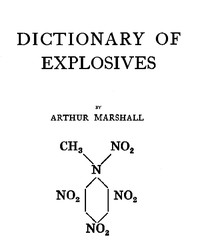
Dictionary of Explosives
Written by Arthur Marshall
Chaptra reads alongside you — AI insights, chapter breakdowns and reader discussions for every book. Join free
About this book
Reading guide
Themes, characters and key ideas in Dictionary of Explosives, written by Chaptra AI.
- about 20 hours
- advanced
- Informative
- Technical
- Systematic
Arthur Marshall's "Dictionary of Explosives" is a crucial early 20th-century technical reference work, meticulously cataloging the rapidly expanding field of explosives. Recognizing the generational gap since the last comprehensive dictionary, Marshall, a chemical inspector, aimed to provide an updated and authoritative guide to modern explosives, including their compositions, classifications, and applications. The book systematically categorizes substances like propellants and high explosives, with a particular focus on proprietary names, nitrocelluloses, and coal-mine explosives. It underscores the rigorous testing and regulatory measures essential for safety and efficacy in their industrial and military uses. This specialized dictionary serves as both a practical guide for its era and an invaluable historical document detailing a pivotal period in chemical engineering and materials science.
“The passage of time since the last dictionary on explosives was produced, which was over a generation ago, has brought forth many new explosives, making an updated reference essential.”
Key themes
- Scientific Advancement and Innovation
- The book's very existence is a testament to the rapid advancements in chemistry and engineering during the late 19th and early 20th centuries. It documents the emergence of numerous new explosive compounds and formulations, highlighting a period of intense innovation in materials science. Marshall's introduction explicitly notes the 'many new explosives' that necessitated an updated reference, underscoring the dynamic nature of the field.
- Safety and Regulation
- Given the inherent dangers of explosives, a significant underlying theme is the critical importance of safety protocols and regulatory oversight. The text explicitly mentions 'rigorous testing and regulatory measures' for certain categories of explosives, particularly those used in hazardous environments like coal mines. This highlights the societal responsibility accompanying the development and deployment of powerful and dangerous technologies, reflecting early attempts to mitigate industrial risks.
- Classification and Systematization of Knowledge
- At its core, the book exemplifies the human endeavor to categorize, organize, and systematize complex information. As a dictionary, its fundamental purpose is to bring order to a diverse and rapidly expanding field. The identification of 'two main categories: propellants and high explosives' and the detailed entries for various substances demonstrate a commitment to clear, logical classification, which is essential for both understanding and practical application of the knowledge.
Worth discussing
How does the need for an updated dictionary reflect the pace of scientific and industrial innovation in the early 20th century?
Chapter-by-chapter breakdowns, character arcs and the full thematic analysis come with a free account.
Discussions
No one has started one yet
Questions this book opens up
No discussions yet
Be the first to start a discussion about this book!
Sign up to start the discussionReviews
No reviews yet
Be the first to review this book!