
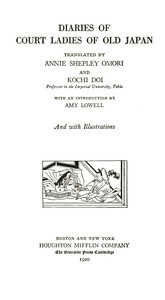
Diaries of Court Ladies of Old Japan
Written by Murasaki Shikibu,Izumi Shikibu,Sugawara no Takasue no Musume
Chaptra reads alongside you — AI insights, chapter breakdowns and reader discussions for every book. Join free
About this book
Reading guide
Themes, characters and key ideas in Diaries of Court Ladies of Old Japan, written by Chaptra AI.
- about 12 hours
- advanced
- introspective
- melancholy
- poetic
This collection, "Diaries of Court Ladies of Old Japan," offers an unparalleled window into the Heian Period through the intimate journals of three prominent noblewomen: Murasaki Shikibu, Izumi Shikibu, and Sugawara no Takasue no Musume (Lady Sarashina). Translated by Annie Shepley Omori and Kochi Doi, these diaries blend personal introspection with detailed observations of court life, showcasing the complex emotional landscapes of love, loss, ambition, and spiritual yearning. From Murasaki Shikibu's reserved observations on court politics and the creation of *The Tale of Genji*, to Izumi Shikibu's passionate poetic exchanges in a tumultuous affair, and Lady Sarashina's lifelong quest for romance and spiritual solace, the volume collectively paints a vibrant yet often melancholic portrait of a refined era and its women. It serves as both a historical document and a profound literary exploration of human experience.
“I was once told that if only I could read all the tales in the world, I should become a beautiful lady with a brilliant mind.”
Key themes
- Transience and Impermanence (Mono no Aware)
- A pervasive theme throughout all three diaries, reflecting the Buddhist concept of the impermanence of all things. It manifests as a deep sensitivity to the fleeting beauty of nature, the brevity of life, the inevitability of loss, and the ephemeral nature of human relationships and courtly glory. This awareness often leads to a gentle melancholy.
- Love and Desire
- Explored in various forms: romantic love, familial affection, and spiritual yearning. Izumi Shikibu's diary vividly portrays passionate, often illicit, romantic love. Lady Sarashina begins with an idealized yearning for romantic love from tales, which later transforms into a desire for spiritual connection. Murasaki Shikibu observes courtly love from a more detached perspective, noting its complexities and consequences.
- Art, Literature, and Self-Expression
- The diaries themselves are prime examples of literary art and self-expression. They highlight the central role of poetry (waka) in Heian communication, social interaction, and emotional outlet. The diarists use writing not only to record events but also to process emotions, reflect on their lives, and create a lasting legacy. Murasaki Shikibu's diary is particularly significant for its insights into the creation of *The Tale of Genji*.
Worth discussing
How do the three diarists' perspectives on love, loss, and ambition differ, and what commonalities do they share?
Chapter-by-chapter breakdowns, character arcs and the full thematic analysis come with a free account.
Discussions
No one has started one yet
Questions this book opens up
No discussions yet
Be the first to start a discussion about this book!
Sign up to start the discussionReviews
No reviews yet
Be the first to review this book!