
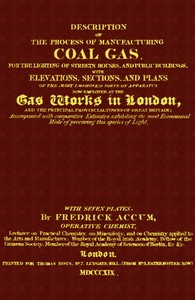
Description of the Process of Manufacturing Coal Gas, for the Lighting of Streets Houses, and Public Buildings: With Elevations, Sections, and Plans of the Most Improved Sorts of Apparatus Now Employed at the Gas Works in London and the Principal Provincial Towns of Great Britain; Accompanied With Comparative Estimates, Exhibiting the Most Economical Mode of Procuring This Species of Light
Written by Friedrich Christian Accum
Chaptra reads alongside you — AI insights, chapter breakdowns and reader discussions for every book. Join free
About this book
Reading guide
Themes, characters and key ideas in Description of the Process of Manufacturing Coal Gas, for the Lighting of Streets Houses, and Public Buildings: With Elevations, Sections, and Plans of the Most Improved Sorts of Apparatus Now Employed at the Gas Works in London and the Principal Provincial Towns of Great Britain; Accompanied With Comparative Estimates, Exhibiting the Most Economical Mode of Procuring This Species of Light, written by Chaptra AI.
- about 8 hours
- advanced
- Informative
- Technical
- Pioneering
Friedrich Christian Accum's "Description of the Process of Manufacturing Coal Gas..." is an early 19th-century scientific treatise detailing the innovative production and application of coal gas for illumination. The work comprehensively outlines the technical processes, apparatus designs, and economic advantages of gas lighting over traditional methods. Accum highlights the rapid adoption of this transformative technology in British cities, emphasizing its significant impact on public safety, societal convenience, and industrial progress. It serves as a pivotal historical document capturing the dawn of modern urban infrastructure and the persuasive advocacy for a revolutionary energy source, laying the groundwork for widespread adoption across Great Britain.
“The advent of coal gas lighting marks a new era in public safety, domestic comfort, and the extension of productive hours for industry.”
Key themes
- Technological Innovation and Progress
- This theme is central to Accum's work, showcasing coal gas lighting as a revolutionary invention transforming society. The book details the advanced engineering and chemical processes involved, presenting them as triumphs of human ingenuity. It implicitly argues that technological advancement is a primary driver of societal improvement, leading to greater convenience, safety, and efficiency.
- Industrialization and Urbanization
- The book directly addresses the practical application of coal gas lighting within the context of rapidly industrializing and urbanizing Britain. It highlights how this technology facilitated the growth of cities by providing reliable street lighting, enabling longer working hours in factories, and improving the quality of life in public and private buildings. It underscores the symbiotic relationship between technological innovation and the demands of a growing industrial economy.
- Economic Efficiency and Utility
- Accum places significant emphasis on the economic advantages of coal gas lighting. The inclusion of 'comparative estimates' explicitly demonstrates his intent to prove the cost-effectiveness and practical utility of the new technology over existing solutions. This theme reflects the utilitarian mindset of the era, where innovations were judged not only by their technical feasibility but also by their financial viability and practical benefits.
Worth discussing
How did the introduction of coal gas lighting fundamentally alter urban life, public safety, and economic activity in 19th-century Britain?
Chapter-by-chapter breakdowns, character arcs and the full thematic analysis come with a free account.
Discussions
No one has started one yet
Questions this book opens up
No discussions yet
Be the first to start a discussion about this book!
Sign up to start the discussionReviews
No reviews yet
Be the first to review this book!