
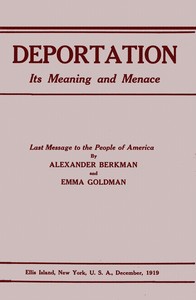
Deportation, its meaning and menace: Last message to the people of America by Alexander Berkman and Emma Goldman
Written by Emma Goldman,Alexander Berkman
Chaptra reads alongside you — AI insights, chapter breakdowns and reader discussions for every book. Join free
About this book
Reading guide
Themes, characters and key ideas in Deportation, its meaning and menace: Last message to the people of America by Alexander Berkman and Emma Goldman, written by Chaptra AI.
- about 2 hours
- advanced
- urgent
- indignant
- polemical
Alexander Berkman and Emma Goldman's "Deportation, its meaning and menace" is a powerful political pamphlet written in the aftermath of World War I, serving as their final message to America before their forced exile. The work vehemently critiques the U.S. government's use of deportation as a tool to suppress dissent, particularly targeting immigrants and political radicals during the Red Scare. Drawing on their personal experiences, Berkman and Goldman expose deportation not merely as a legal punishment but as a mechanism designed to instill fear, control the working class, and stifle fundamental freedoms like speech and thought. They argue that this state-sanctioned repression undermines the very principles of democracy and social justice, urging readers to recognize the inherent dangers and unite in solidarity against such authoritarian tactics.
“Deportation is not merely a punishment for an individual; it is a weapon of fear, a mechanism to silence dissent and control the working class.”
Key themes
- Freedom of Speech and Dissent
- This is the core philosophical pillar of the pamphlet. Berkman and Goldman argue vehemently that the ability to express unpopular or radical ideas, and to dissent from government policy, is fundamental to a free society. They see deportation as a direct attack on this freedom, designed to silence critical voices and enforce conformity.
- State Repression and Authoritarianism
- The pamphlet serves as a stark warning against the dangers of unchecked state power. Berkman and Goldman illustrate how the government, under the guise of national security (post-WWI Red Scare), can employ extreme measures like mass deportations to quash political opposition, thereby moving towards authoritarianism. They analyze deportation as a systemic tool of control, not just isolated incidents.
- Immigration and Xenophobia
- The authors critically expose how immigrant status was weaponized during the Red Scare. They highlight the xenophobic attitudes prevalent in society and government, which allowed for the targeting and dehumanization of immigrants, particularly those with leftist political leanings. Deportation, in this context, is presented as an extension of anti-immigrant sentiment.
Worth discussing
How do Berkman and Goldman define 'deportation' beyond its legal meaning, and what 'menace' do they believe it poses to society?
Chapter-by-chapter breakdowns, character arcs and the full thematic analysis come with a free account.
Discussions
No one has started one yet
Questions this book opens up
No discussions yet
Be the first to start a discussion about this book!
Sign up to start the discussionReviews
No reviews yet
Be the first to review this book!