
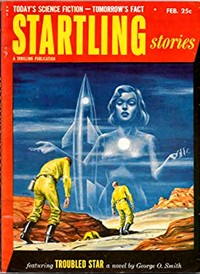
Definition
Written by Damon Knight
Chaptra reads alongside you — AI insights, chapter breakdowns and reader discussions for every book. Join free
About this book
Reading guide
Themes, characters and key ideas in Definition, written by Chaptra AI.
- about 2 hours
- intermediate
- mysterious
- philosophical
- thought-provoking
Damon Knight's "Definition" is a seminal 1950s science fiction short story set in a future where humanity explores space, confronting challenges to identity and consciousness. The narrative follows Charles and Midge Samson, who investigate the mysterious disappearance of a fellow traveler, Jackson, after his encounter with the enigmatic Kassids. The Kassids are revealed not as a race, but as a profound philosophical concept capable of fundamentally altering human existence. As the Samsons delve deeper, they grapple with complex questions about human nature, love, peace, and the potential existential threat posed by a unifying belief system. The story culminates in a deeply unsettling realization about humanity's place and the true cost of progress, leaving readers to ponder the weight of its philosophical revelations.
“"The Kassids aren't a people, Midge. They're an *idea*."”
Key themes
- Identity and Consciousness
- The central theme, explored through the Kassids' ability to challenge and potentially redefine what it means to be human. The story delves into whether individual identity is essential or an impediment to a higher state of consciousness or unity. It questions the boundaries of self and the implications of merging individual minds or essences into a collective.
- The Nature of Progress and Utopia
- The story critically examines the concept of 'progress,' particularly when it involves radical changes to human nature. The Kassids represent a potential utopian ideal of peace and unity, but the narrative questions the cost of such a utopia, suggesting that some forms of progress might entail an unacceptable loss of core human attributes, such as love, conflict, and individuality. It poses a moral quandary about whether all forms of 'advancement' are inherently good.
- The Enigma of the Other
- The story uses the Kassids as a representation of the 'Other' – something fundamentally different and challenging to human understanding. Unlike typical alien encounters, the Kassids are an 'idea,' making them even more enigmatic and difficult to categorize or combat. This theme explores humanity's reaction to the unknown and the profoundly alien, particularly when that 'alienness' is philosophical rather than biological, forcing introspection on what constitutes 'us' versus 'them.'
Worth discussing
How does the story challenge traditional definitions of 'humanity' and 'consciousness'?
Chapter-by-chapter breakdowns, character arcs and the full thematic analysis come with a free account.
Discussions
No one has started one yet
Questions this book opens up
No discussions yet
Be the first to start a discussion about this book!
Sign up to start the discussionReviews
No reviews yet
Be the first to review this book!