
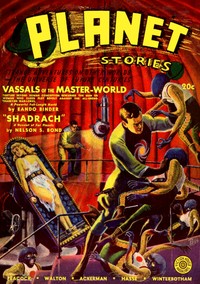
Dead Man's Planet
Written by R. R. (Russell Robert) Winterbotham
Chaptra reads alongside you — AI insights, chapter breakdowns and reader discussions for every book. Join free
About this book
Reading guide
Themes, characters and key ideas in Dead Man's Planet, written by Chaptra AI.
- about 8 hours
- intermediate
- mysterious
- isolating
- tense
R. R. Winterbotham's "Dead Man's Planet," an early 1940s science fiction novel, plunges two astronauts, Mick Conner and Alf Rankin, into a chilling discovery on a seemingly barren asteroid. What begins as a routine repair stop quickly unravels into an investigation of unique, aggressive plant life and the enigmatic Ghor, who claims to be the asteroid's sole human inhabitant. As the astronauts uncover the tragic legacy of Ghor's father's bio-engineering experiments, they face escalating dangers, culminating in Ghor's poignant sacrifice. The narrative ultimately explores profound themes of identity, the blurred lines between humanity and nature, and the ethical consequences of scientific manipulation.
“"This planet isn't dead, Conner. It's just… waiting."”
Key themes
- Identity and Self-Acceptance
- Ghor's journey is fundamentally one of identity. As a being of both human and plant origin, he struggles with what he is and where he belongs. His ultimate sacrifice is an act of self-definition, embracing his unique nature for a greater purpose.
- Isolation
- The theme of isolation is central, manifested by the barren asteroid setting and Ghor's solitary existence. It explores the psychological toll of being cut off from civilization and the unique challenges faced when encountering truly alien life forms in a desolate environment.
- Consequences of Scientific Experiments Gone Awry
- This theme serves as the narrative's backbone, exploring the dangers of unchecked scientific ambition and the ethical responsibilities that come with manipulating life. Ghor's existence and the aggressive plant life are direct results of his father's hubris.
Worth discussing
How does the novel explore the theme of isolation, both physical and existential, for the characters?
Chapter-by-chapter breakdowns, character arcs and the full thematic analysis come with a free account.
Discussions
No one has started one yet
Questions this book opens up
No discussions yet
Be the first to start a discussion about this book!
Sign up to start the discussionReviews
No reviews yet
Be the first to review this book!