
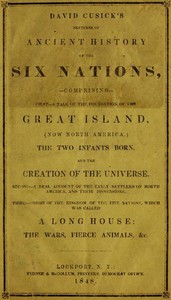
David Cusick's Sketches of Ancient History of the Six Nations: Comprising First—A Tale of the Foundation of the Great Island, (Now North America), The Two Infants Born, and the Creation of the Universe. Second—A Real Account of the Early Settlers of north America, and Their Dissensions. Third—Origin of the Kingdom of the Five Nations, Which Was Called a Long House: the Wars, Fierce Animals, &c.
Written by David Cusick
Chaptra reads alongside you — AI insights, chapter breakdowns and reader discussions for every book. Join free
About this book
Reading guide
Themes, characters and key ideas in David Cusick's Sketches of Ancient History of the Six Nations: Comprising First—A Tale of the Foundation of the Great Island, (Now North America), The Two Infants Born, and the Creation of the Universe. Second—A Real Account of the Early Settlers of north America, and Their Dissensions. Third—Origin of the Kingdom of the Five Nations, Which Was Called a Long House: the Wars, Fierce Animals, &c., written by Chaptra AI.
- about 8 hours
- intermediate
- Mythological
- Historical
- Ancestral
David Cusick's "Sketches of Ancient History of the Six Nations" is a seminal 19th-century work that compiles the foundational myths and historical narratives of the Haudenosaunee (Iroquois) Confederacy. Divided into three parts, it begins with a vibrant creation myth featuring the cosmic struggle between twin brothers, Enigorio (the good mind) and Enigonhahgetgea (the bad mind), setting the stage for the world's dualistic nature. The subsequent sections delve into accounts of early North American settlers, interactions with mythical giants, and the formation and challenges faced by the original Five Nations, culminating in the establishment of the Long House and its principles of governance. This unique text offers an invaluable indigenous perspective on history, spirituality, and societal structure, blending folklore with historical events to champion unity, resilience, and cultural continuity against external pressures.
“Before the formation of the earth, this continent was inhabited by two distinct races of beings, the Good Mind and the Bad Mind.”
Key themes
- Governance and Confederacy
- A foundational theme, particularly in Part Three, detailing the evolution of the disparate Five Nations into the powerful and enduring Haudenosaunee Confederacy, known as the Long House. It emphasizes the principles of unity, collective decision-making, peace, and mutual defense that allowed the nations to overcome internal strife and external threats, establishing a sophisticated model of indigenous governance.
- Creation and Cosmic Duality
- This theme is central to Part One, illustrating the Haudenosaunee worldview of how the world came into being through the Sky Woman and the subsequent struggle between the twin brothers, Enigorio (good) and Enigonhahgetgea (bad). It explains the origin of both beneficial and harmful elements in nature and human experience, establishing a fundamental principle of balance and opposition that permeates their cosmology.
- Cultural Memory and Identity
- The entire book serves as a powerful testament to the importance of cultural memory and identity for the Haudenosaunee people. Cusick's work is an act of preserving and transmitting the oral traditions, myths, and historical narratives that define who they are, ensuring these stories endure through generations and against the pressures of assimilation. It asserts an indigenous claim to history and a distinct cultural heritage.
Worth discussing
How does Cusick's narrative challenge or complement traditional Western historical accounts of North America's past?
Chapter-by-chapter breakdowns, character arcs and the full thematic analysis come with a free account.
Discussions
No one has started one yet
Questions this book opens up
No discussions yet
Be the first to start a discussion about this book!
Sign up to start the discussionReviews
No reviews yet
Be the first to review this book!