
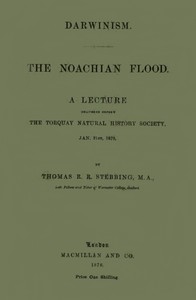
Darwinism. The Noachian Flood: A lecture delivered before the Torquay Natural History Society, Jan. 31st, 1870
Written by Thomas Roscoe Rede Stebbing
Chaptra reads alongside you — AI insights, chapter breakdowns and reader discussions for every book. Join free
About this book
Reading guide
Themes, characters and key ideas in Darwinism. The Noachian Flood: A lecture delivered before the Torquay Natural History Society, Jan. 31st, 1870, written by Chaptra AI.
- about 8 hours
- advanced
- analytical
- challenging
- rational
Thomas Roscoe Rede Stebbing's 1870 lecture, "Darwinism. The Noachian Flood," critically examines the biblical narrative of a universal deluge through the lens of contemporary scientific knowledge. Stebbing meticulously argues that a global flood presents insurmountable scientific contradictions, particularly in geology and biology, advocating instead for a localized interpretation of the Noachian Flood. He challenges traditional literal readings by highlighting inconsistencies with natural history and Darwinian theory, ultimately proposing a reconciliation between religious narratives and scientific inquiry. The work encourages a re-evaluation of long-held beliefs in light of empirical evidence, positing a regional inundation as more plausible than a worldwide catastrophe.
“The notion of a universal deluge, when subjected to the crucible of scientific inquiry, reveals a tapestry of insurmountable contradictions.”
Key themes
- Science vs. Religion/Faith
- This is the central theme, exploring the perceived conflict between scientific discoveries, particularly Darwinian evolution and geological findings, and traditional religious beliefs, specifically the literal interpretation of the biblical flood narrative. Stebbing navigates this tension by advocating for a resolution that respects both empirical truth and spiritual meaning.
- Biblical Interpretation (Literal vs. Regional/Metaphorical)
- Stebbing directly addresses the methodology of interpreting sacred texts. He argues against a strictly literal reading of the Noachian Flood, proposing instead that the narrative describes a significant regional inundation. This challenges dogmatic literalism and opens the door for more nuanced, contextual, and scientifically informed interpretations.
- The Authority of Scientific Evidence
- The lecture champions the supremacy of empirical observation and rational inquiry in understanding the natural world. Stebbing asserts that scientific evidence, derived from geology and biology, should be given precedence over traditional narratives when they are in direct conflict, advocating for an evidence-based worldview.
Worth discussing
How does Stebbing's approach to reconciling science and religion compare to modern attempts, and what lessons can be learned?
Chapter-by-chapter breakdowns, character arcs and the full thematic analysis come with a free account.
Discussions
No one has started one yet
Questions this book opens up
No discussions yet
Be the first to start a discussion about this book!
Sign up to start the discussionReviews
No reviews yet
Be the first to review this book!