
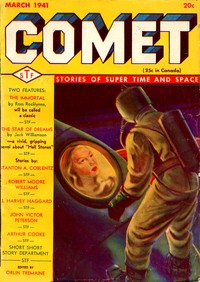
Dark Reality
Written by Robert Moore Williams
Chaptra reads alongside you — AI insights, chapter breakdowns and reader discussions for every book. Join free
About this book
Reading guide
Themes, characters and key ideas in Dark Reality, written by Chaptra AI.
- about 8 hours
- intermediate
- dark
- mysterious
- philosophical
Robert Moore Williams' "Dark Reality" is an early 20th-century science fiction novel that plunges into profound philosophical questions regarding fate, existence, and the recurring patterns of human civilization. The narrative centers on Lee Garth, a brilliant 1940s physicist whose groundbreaking work inadvertently uncovers a looming crisis for humanity two million years in the future. Obsessed with an enigmatic sphere linked to human destinies, Garth witnesses mysterious disappearances, revealing an urgent need to repopulate a dying world by tapping into collective human consciousness. This gripping tale intertwines science and philosophy, culminating in Garth's quest to rectify historical errors and compel readers to ponder humanity's place in the cosmos and the ultimate nature of reality.
“"The true dark reality is not what lies ahead, but the shadows cast by the choices we refuse to confront."”
Key themes
- Survival of the Species and Existence
- At the core of "Dark Reality" is the existential crisis of humanity's survival. The novel presents an 'unimaginable dilemma related to the survival of the species' and a 'dying world two million years into the future.' This forces characters and readers to confront the fragility of existence and what it truly means for humanity to endure across vast spans of time. It delves into the ultimate purpose and value of human life.
- Fate vs. Free Will
- The novel deeply explores the tension between preordained destiny and human agency. The 'enigmatic sphere connected to humans' destinies' and the 'cyclical nature of human history' suggest a deterministic view, while Lee Garth's 'bid to correct historical errors' champions the idea that humanity can alter its course. This theme questions whether our choices truly matter or if we are merely playing out a predetermined script.
- The Responsibility of Scientific Progress
- Lee Garth's 'groundbreaking work' is the catalyst for uncovering humanity's dilemma, highlighting the profound ethical implications that come with advanced scientific discovery. The novel implicitly asks what responsibility scientists have for the potential consequences, both immediate and far-future, of their research. It explores the moral tightrope walked by those who push the boundaries of knowledge.
Worth discussing
To what extent is humanity's future predetermined by its past, and how much agency do individuals truly possess?
Chapter-by-chapter breakdowns, character arcs and the full thematic analysis come with a free account.
Discussions
No one has started one yet
Questions this book opens up
No discussions yet
Be the first to start a discussion about this book!
Sign up to start the discussionReviews
No reviews yet
Be the first to review this book!