
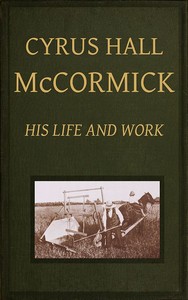
Cyrus Hall McCormick: His Life and Work
Written by Herbert Newton Casson
Chaptra reads alongside you — AI insights, chapter breakdowns and reader discussions for every book. Join free
About this book
Reading guide
Themes, characters and key ideas in Cyrus Hall McCormick: His Life and Work, written by Chaptra AI.
- about 9 hours
- intermediate
- Informative
- Historical
- Inspiring
Herbert Newton Casson's "Cyrus Hall McCormick: His Life and Work" provides a historical biography of the inventor of the mechanical reaper, tracing his journey from his early life in Virginia to his profound impact on American agriculture and industry. The book details the dire need for agricultural innovation in the early 19th century and how McCormick's invention served as a pivotal solution, revolutionizing farming practices and contributing significantly to the nation's industrial growth. Beyond chronicling the invention itself, Casson explores the entrepreneurial challenges McCormick faced in manufacturing, patenting, and popularizing his groundbreaking tool. Ultimately, the text serves as both a testament to individual ingenuity and a chronicle of a transformative period in American economic history.
“The fertile fields of America cried out for a champion, a tool to unlock their boundless potential.”
Key themes
- Innovation and Invention
- This is the central theme, exploring the process of creating a groundbreaking technology and its profound impact. The book details not just the moment of invention but the iterative process of refinement, the challenges of patenting, and the necessity of vision to bring a new idea to fruition. It champions the power of human ingenuity to solve pressing societal problems.
- Industrialization and Progress
- The book explores how McCormick's invention was not an isolated event but a driving force in America's broader industrial revolution. It illustrates the shift from agrarian, manual labor-based economies to mechanized, factory-driven production. This theme highlights the interconnectedness of technological advancement with economic growth, urbanization, and the rise of the United States as an industrial power.
- Transformation of Agriculture
- The book vividly portrays the dramatic shift from labor-intensive, often inefficient farming methods to mechanized agriculture. It underscores how McCormick's reaper fundamentally altered the relationship between humans, land, and food production, leading to increased yields, reduced labor, and profound changes in rural life and demographics. This theme is about the evolution of a core human activity.
Worth discussing
How did the agricultural conditions of the early 19th century create a fertile ground for an invention like the mechanical reaper?
Chapter-by-chapter breakdowns, character arcs and the full thematic analysis come with a free account.
Discussions
No one has started one yet
Questions this book opens up
No discussions yet
Be the first to start a discussion about this book!
Sign up to start the discussionReviews
No reviews yet
Be the first to review this book!