
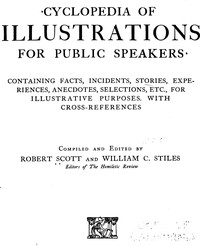
Cyclopedia of illustrations for public speakers : $b Containing facts, incidents, stories, experiences, anecdotes, selections, etc., for illustrative purposes, with cross-references
Written by Unknown author
Chaptra reads alongside you — AI insights, chapter breakdowns and reader discussions for every book. Join free
About this book
Reading guide
Themes, characters and key ideas in Cyclopedia of illustrations for public speakers : $b Containing facts, incidents, stories, experiences, anecdotes, selections, etc., for illustrative purposes, with cross-references, written by Chaptra AI.
- about 15 hours
- intermediate
- Informative
- Practical
- Resourceful
The "Cyclopedia of Illustrations for Public Speakers" is a comprehensive reference work designed to equip orators with a vast array of illustrative material. It compiles facts, incidents, stories, experiences, anecdotes, and selections, all meticulously organized and cross-referenced to serve as compelling examples and rhetorical aids. Far from a narrative, it functions as a practical toolkit, enabling speakers to effectively engage, persuade, and entertain their audiences by drawing upon a rich repository of pre-vetted content. Its primary purpose is to enhance clarity, memorability, and impact in public discourse across various topics and occasions.
“"The true art of public speaking lies not only in what you say, but how vividly you make your audience see and feel your message through apt illustration."”
Key themes
- Effective Communication
- The overarching theme is the pursuit of effective communication. The book serves as a tool to help speakers convey their messages with clarity, impact, and memorability. It implicitly argues that well-chosen illustrations are crucial for engaging an audience and making abstract ideas tangible.
- Persuasion and Rhetoric
- This theme explores how illustrative content can be used to influence an audience's beliefs, attitudes, and actions. The cyclopedia provides the raw material for rhetorical appeals – logos (logic via facts), pathos (emotion via stories), and ethos (credibility via relatable experiences).
- The Power of Storytelling
- This theme underscores the inherent human connection to narratives. The cyclopedia's very existence is a testament to the belief that stories, incidents, and anecdotes are uniquely powerful tools for capturing attention, conveying complex information, and fostering empathy, making messages memorable and relatable.
Worth discussing
How do the types of illustrations found in this cyclopedia reflect the cultural and moral values of the era in which it was compiled?
Chapter-by-chapter breakdowns, character arcs and the full thematic analysis come with a free account.
Discussions
No one has started one yet
Questions this book opens up
No discussions yet
Be the first to start a discussion about this book!
Sign up to start the discussionReviews
No reviews yet
Be the first to review this book!