
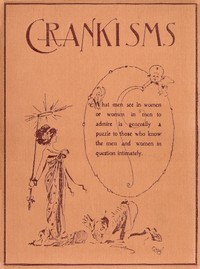
Crankisms
Written by Lisle de Vaux Matthewman
Chaptra reads alongside you — AI insights, chapter breakdowns and reader discussions for every book. Join free
About this book
Reading guide
Themes, characters and key ideas in Crankisms, written by Chaptra AI.
- about 4 hours
- intermediate
- humorous
- witty
- satirical
Lisle de Vaux Matthewman's "Crankisms" is a collection of pithy, humorous, and often satirical observations, aphorisms, and short anecdotes. Rather than a narrative, the book presents a series of disconnected 'crankisms' – witty remarks or droll comments on human nature, societal conventions, and the absurdities of daily life. Published in an era known for its appreciation of epigrammatic wit, it offers a window into the social commentary and comedic sensibilities of the early 20th century. The work is characterized by its brevity, sharp wit, and a generally lighthearted yet incisive critique of common follies and pretensions.
“A man's character is often revealed by the company he avoids.”
Key themes
- Human Folly and Absurdity
- This theme explores the inherent irrationality, illogical thinking, and self-deception prevalent in human behavior. Matthewman's 'crankisms' frequently highlight the comical and often contradictory ways people think, speak, and act, exposing the gap between intention and outcome, or belief and reality.
- Social Critique and Satire
- The book serves as a sharp, albeit often gentle, critique of societal norms, conventions, and pretenses of the early 20th century. Matthewman satirizes class distinctions, the superficiality of polite society, the hypocrisy embedded in social rituals, and the often-empty rhetoric of public life.
- The Power and Limitations of Language/Wit
- Matthewman's entire work is a testament to the power of language and wit as tools for observation, commentary, and amusement. The theme explores how carefully chosen words, irony, and clever phrasing can distill complex ideas, expose truths, and elicit laughter, while also implicitly acknowledging the limitations of language to fully capture reality.
Worth discussing
How does Matthewman use brevity and wit to deliver social commentary?
Chapter-by-chapter breakdowns, character arcs and the full thematic analysis come with a free account.
Discussions
No one has started one yet
Questions this book opens up
No discussions yet
Be the first to start a discussion about this book!
Sign up to start the discussionReviews
No reviews yet
Be the first to review this book!