
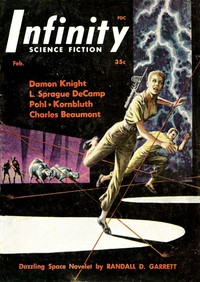
Course of Empire
Written by Richard Wilson
Chaptra reads alongside you — AI insights, chapter breakdowns and reader discussions for every book. Join free
About this book
Reading guide
Themes, characters and key ideas in Course of Empire, written by Chaptra AI.
- about 8 hours
- intermediate
- humorous
- critical
- ironic
Richard Wilson's "Course of Empire" is a mid-20th-century science fiction short story that satirizes human hubris and the futility of colonization efforts. Told through the retrospective conversation of Roger Boynton and Allister, the narrative recounts the comical failures of human attempts to colonize Mars, Venus, and Jupiter under a World Government. These endeavors were consistently undermined by whimsical decisions, cultural misunderstandings with local fauna, and environmental miscalculations, leading to widespread inefficiency and unexpected outcomes. The story culminates in a sharp twist of irony, revealing that while humanity struggled to establish its empire, the intelligent 'Medeans of Ganymede successfully colonized Earth, underscoring the unpredictable nature of interplanetary relations and the grand illusion of human superiority.
“"We thought we knew best, didn't we? Imposing our 'civilization' on planets that had perfectly good ones, or at least perfectly good ways of not needing ours."”
Key themes
- Colonization and Imperialism
- The central theme, explored through humanity's failed attempts to establish colonies on Mars, Venus, and Jupiter's moons. The story critiques the inherent arrogance and inefficiency of imperialistic endeavors, especially when driven by a 'World Government' that makes whimsical and ill-informed decisions. It challenges the notion that colonization is a natural or beneficial extension of human ambition.
- Human Hubris and Folly
- The story consistently highlights humanity's overconfidence and flawed decision-making. Despite grand ambitions, the colonization efforts are undone by basic misunderstandings of alien environments and a refusal to adapt. This hubris blinds humans to their own limitations and, ultimately, to the threat (or opportunity) posed by the 'Medeans.
- Ironic Reversal and Unintended Consequences
- The story's climax, where the 'Medeans colonize Earth, is a powerful example of ironic reversal. Humanity's efforts to establish an empire lead not to success but to its own subjugation, an unintended and deeply humbling consequence of its self-absorbed expansionism. This highlights the unpredictable nature of complex systems and interactions.
Worth discussing
How does 'Course of Empire' use humor to deliver its critique of human colonization?
Chapter-by-chapter breakdowns, character arcs and the full thematic analysis come with a free account.
Discussions
No one has started one yet
Questions this book opens up
No discussions yet
Be the first to start a discussion about this book!
Sign up to start the discussionReviews
No reviews yet
Be the first to review this book!