
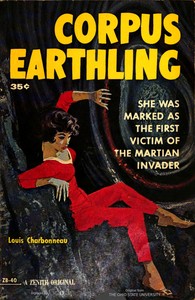
Corpus earthling
Written by Louis Charbonneau
Chaptra reads alongside you — AI insights, chapter breakdowns and reader discussions for every book. Join free
About this book
Reading guide
Themes, characters and key ideas in Corpus earthling, written by Chaptra AI.
- about 8 hours
- intermediate
- Mysterious
- Dark
- Suspenseful
Louis Charbonneau's "Corpus Earthling" is a late 20th-century science fiction novel that plunges literature professor Paul Cameron into a terrifying psychological ordeal. Haunted by vivid nightmares and enigmatic voices, Cameron fears he's losing his sanity, only to discover he may be at the center of a malevolent alien conspiracy. As he grapples with these internal and external threats, he becomes entangled in a local murder mystery and a complex relationship with a student, Laurie Hendricks. The narrative masterfully blends psychological suspense with extraterrestrial horror, creating a tense atmosphere where reality itself seems to unravel, forcing Cameron to distinguish between delusion and a sinister truth.
“The whispers started subtly, like static on a forgotten radio frequency, but now they are a chorus, demanding I walk into the sea.”
Key themes
- Sanity vs. Insanity
- This is the central theme, explored through Paul Cameron's terrifying struggle to distinguish between genuine alien manipulation and a complete psychological breakdown. The novel constantly blurs the lines, forcing the reader to question Cameron's perceptions and the very nature of reality. It delves into the fragility of the human mind when confronted with the incomprehensible.
- Paranoia and Trust
- The novel masterfully builds an atmosphere of paranoia, not just within Cameron's mind, but also externally as he questions everyone around him. The theme explores how an individual copes when they can trust neither their own senses nor the people in their life, especially when a conspiracy theory seems to be manifesting as reality.
- Alien Invasion and Existential Threat
- Beyond a conventional invasion, the novel explores an insidious, psychological form of alien subjugation. It poses profound questions about humanity's place in the cosmos, the nature of consciousness, and the terrifying possibility that our planet and our minds are not our own. The threat is not just to life, but to autonomy and identity.
Worth discussing
How does Charbonneau blur the lines between psychological breakdown and genuine alien invasion? What evidence supports each interpretation?
Chapter-by-chapter breakdowns, character arcs and the full thematic analysis come with a free account.
Discussions
No one has started one yet
Questions this book opens up
No discussions yet
Be the first to start a discussion about this book!
Sign up to start the discussionReviews
No reviews yet
Be the first to review this book!