
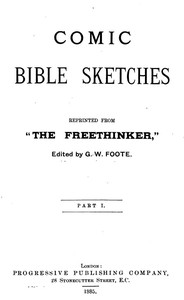
Comic Bible Sketches, Reprinted from "The Freethinker"
Written by G. W. (George William) Foote
Chaptra reads alongside you — AI insights, chapter breakdowns and reader discussions for every book. Join free
About this book
Reading guide
Themes, characters and key ideas in Comic Bible Sketches, Reprinted from "The Freethinker", written by Chaptra AI.
- about 8 hours
- intermediate
- humorous
- satirical
- provocative
G. W. Foote's "Comic Bible Sketches" is a late 19th-century collection of satirical illustrations and accompanying texts, originally published in "The Freethinker." It employs humor and sharp wit to lampoon biblical narratives, challenging their traditional authority and perceived infallibility. Emerging from an era of intense debate between religion and science, the book reflects growing skepticism by highlighting absurdities and contradictions within the scriptures. Through a comedic lens, Foote aims to provoke critical thought, encouraging readers to question established religious doctrines and embrace a free-thinking approach to belief. This work serves as both a critique of religious dogma and a significant piece of social satire from its time.
“"The greatest miracle, perhaps, is not that these tales were believed, but that they continue to be so."”
Key themes
- Critique of Religious Dogma
- The foundational theme of the book, Foote systematically dismantles the unquestioning acceptance of religious doctrines. He challenges the literal interpretation of the Bible, exposing what he perceives as its logical inconsistencies, scientific inaccuracies, and ethical failings, thereby undermining its authority as an infallible divine text.
- Skepticism and Free Thought
- Foote champions the principles of skepticism and free thought, encouraging readers to apply reason and critical inquiry to all claims, especially those presented as sacred or beyond questioning. The book is an exercise in intellectual liberation, advocating for individual judgment over dogmatic adherence.
- Absurdity and Contradiction
- A core technique of Foote's satire is to highlight the inherent absurdities and contradictions within biblical narratives. By juxtaposing the solemnity of religious claims with their perceived illogical or comical elements, he aims to diminish their sacred aura and reveal their human-made qualities.
Worth discussing
How does Foote use humor to challenge religious authority, and what are the strengths and limitations of this approach?
Chapter-by-chapter breakdowns, character arcs and the full thematic analysis come with a free account.
Discussions
No one has started one yet
Questions this book opens up
No discussions yet
Be the first to start a discussion about this book!
Sign up to start the discussionReviews
No reviews yet
Be the first to review this book!