
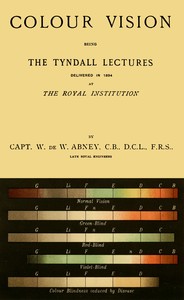
Colour vision : $b Being the Tyndall Lectures delivered in 1894 at the Royal Institution
Written by William de Wiveleslie Abney
Chaptra reads alongside you — AI insights, chapter breakdowns and reader discussions for every book. Join free
About this book
Reading guide
Themes, characters and key ideas in Colour vision : $b Being the Tyndall Lectures delivered in 1894 at the Royal Institution, written by Chaptra AI.
- about 8 hours
- advanced
- Informative
- Analytical
- Didactic
Sir William de Wiveleslie Abney's "Colour Vision" comprises the Tyndall Lectures delivered in 1894, offering a comprehensive scientific exploration of human color perception. The book delves into both the physiological and physical mechanisms underpinning how humans perceive color, alongside an examination of various theories related to color blindness. Through a blend of experimental data and theoretical discussions, Abney elucidates the intricate processes of vision, beginning with a foundational understanding of ocular anatomy. It serves as a significant historical document, showcasing late 19th-century scientific thought and methodology in the field of optics and human physiology.
“The perception of colour is not merely a physical phenomenon, but a complex physiological process occurring within the eye and brain.”
Key themes
- The Nature of Perception
- This theme explores the fundamental question of how subjective experience, particularly the sensation of colour, arises from objective physical stimuli. Abney meticulously details the physiological processes that convert light into neural signals, and how these signals are interpreted by the brain, highlighting the complex interplay between the physical world and our internal representation of it. He grapples with the idea that colour is not an inherent property of light but a construct of the visual system.
- The Scientific Method and Empiricism
- Abney's lectures are a testament to the power of the scientific method, emphasizing rigorous observation, controlled experimentation, and the formulation of testable hypotheses. The book showcases how scientific understanding is built incrementally through empirical evidence, challenging existing theories and proposing new ones based on systematic inquiry. It highlights the importance of quantitative measurement and the careful design of experiments to isolate variables and draw accurate conclusions.
- The Physiology of Vision
- A core focus of Abney's work is the detailed exploration of the biological structures and functions of the eye that enable vision. He meticulously describes the roles of different parts of the retina, such as the macula lutea and fovea centralis, in perceiving light and colour. This theme underscores the intricate biological engineering of the human visual system and how its specific components contribute to the overall process of sight and colour discrimination.
Worth discussing
How did the scientific understanding of colour vision in the late 19th century differ from contemporary theories?
Chapter-by-chapter breakdowns, character arcs and the full thematic analysis come with a free account.
Discussions
No one has started one yet
Questions this book opens up
No discussions yet
Be the first to start a discussion about this book!
Sign up to start the discussionReviews
No reviews yet
Be the first to review this book!