
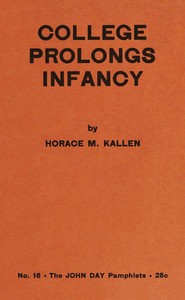
College prolongs infancy
Written by Horace Meyer Kallen
Chaptra reads alongside you — AI insights, chapter breakdowns and reader discussions for every book. Join free
About this book
Reading guide
Themes, characters and key ideas in College prolongs infancy, written by Chaptra AI.
- about 8 hours
- advanced
- critical
- analytical
- provocative
Horace M. Kallen's "College Prolongs Infancy," an early 20th-century critical essay, dissects the American higher education system, arguing that it inadvertently extends students' immaturity rather than preparing them for the rigors of adult life. Kallen contends that university ideals and curricula are largely detached from real-world challenges, fostering a detrimental dependency and childishness. He illustrates how graduates often emerge ill-equipped for practical responsibilities, having focused on theoretical knowledge lacking applicable value. The essay ultimately calls for a radical reformation of educational practices to better align with personal development and societal engagement, emphasizing the urgency of fostering maturity and responsibility.
“Our colleges, far from being crucibles of maturity, have become prolongers of infancy.”
Key themes
- Critique of Higher Education
- The central theme, Kallen systematically dismantles the perceived failures of colleges and universities to fulfill their stated mission. He argues that the system is fundamentally flawed in its approach to preparing students for adult life, highlighting issues with curriculum, environment, and pedagogical philosophy.
- Maturity vs. Infancy
- This theme explores the core tension of the book: the failure of higher education to foster genuine maturity and independence, instead perpetuating a state of 'infancy' or prolonged adolescence. Kallen emphasizes the psychological and social implications of this arrested development.
- Relevance of Education to Real Life
- Kallen critically examines the practical utility of a college education, arguing that much of the curriculum and pedagogical approach lacks direct application to the challenges and demands of adult professional and civic life. He advocates for an education that is directly aligned with real-world needs.
Worth discussing
To what extent do modern higher education institutions still 'prolong infancy' as Kallen suggests?
Chapter-by-chapter breakdowns, character arcs and the full thematic analysis come with a free account.
Discussions
No one has started one yet
Questions this book opens up
No discussions yet
Be the first to start a discussion about this book!
Sign up to start the discussionReviews
No reviews yet
Be the first to review this book!