
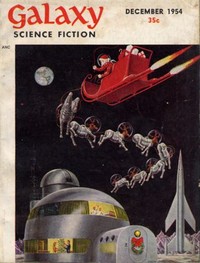
Collector's Item
Written by Evelyn E. Smith
Chaptra reads alongside you — AI insights, chapter breakdowns and reader discussions for every book. Join free
About this book
Read it with a club
Chaptra's fiction clubs — small groups reading the same books and talking as they go.


CraxMe Readers Book Club
Fiction
- 385 members
- 227 discussions
- Started December 2025
Welcome to the Readers Book Club. This is an informal group for like-minded people, where you can discuss books, share and recommend, track your reading progress, and lots more. Discuss Books — all about books. Discuss a particular book or genre, share your favourite quotes. Book Reviews — loved a book and highly recommend it? Or was it just average? Share your review and discuss with fellow readers. (May contain spoilers.) Group Reads — what is a book club without a group read! Buddy Reads — planning to read a book and looking for someone to read it with? Post in the Buddy Read request thread, find a reading buddy, and start discussing.
Read Collector's Item alongside people who are reading it too.
Also here: Doorstops, First Lines Club
Chaptra Prime — paid clubs, every club feature, and unlimited reading support, for $5 a month or $60 once.
See PrimeReading guide
Themes, characters and key ideas in Collector's Item, written by Chaptra AI.
- about 8 hours
- intermediate
- humorous
- adventurous
- mysterious
Evelyn E. Smith's "Collector's Item" is a mid-20th century science fiction novel set on a hostile Venus, where a team of Earth scientists led by Professor Bernardi confronts the planet's formidable environment and its intelligent, telepathic lizard-like inhabitants. Initially believing themselves to be the sole intelligent species, the humans soon find their assumptions challenged by Jrann-Pttt and Dfar-Lll, who possess their own complex motivations. The narrative delves into profound questions of intelligence, identity, and interspecies relations, exploring what truly constitutes 'civilization.' Blending adventure and humor with deeper philosophical inquiries, the story culminates in an unexpected twist that redefines notions of captivity and autonomy.
“"We came to explore, to discover, to claim. We never imagined we might ourselves be the discovery."”
Key themes
- Intelligence and Civilization
- The novel profoundly questions what constitutes 'intelligence' and 'civilization.' Initially, humans assume their technological prowess and social structures define them as superior. However, the telepathic and subtly manipulative Venusians, despite lacking overt technology, demonstrate a different, perhaps more advanced, form of intelligence. The theme challenges the reader to look beyond superficial markers and consider deeper forms of understanding and social organization.
- Captivity and Autonomy
- This theme is central to the novel's ultimate twist and its profound impact. It explores the nature of freedom and imprisonment, questioning whether physical restraint is the only form of captivity. The Venusians demonstrate a more sophisticated form of control, where the 'captives' are unaware of their lack of autonomy, believing themselves to be free explorers. This raises deep questions about the illusion of choice and the true meaning of freedom.
- Identity and Self-Perception
- Both the human and alien characters grapple with their identities throughout the story. The humans, particularly Professor Bernardi, are forced to shed their preconceived notions of themselves as explorers and masters of the universe, confronting a new reality where they are neither. The aliens, in turn, maintain a carefully constructed identity to facilitate their agenda, revealing their true nature only at the critical juncture. The theme explores how external circumstances and unexpected encounters can radically alter one's understanding of self.
Worth discussing
How does the novel challenge traditional human-centric definitions of 'intelligence' and 'civilization'?
Chapter-by-chapter breakdowns, character arcs and the full thematic analysis come with a free account.
Discussions
No one has started one yet
Questions this book opens up
No discussions yet
Be the first to start a discussion about this book!
Sign up to start the discussionReviews
No reviews yet
Be the first to review this book!