
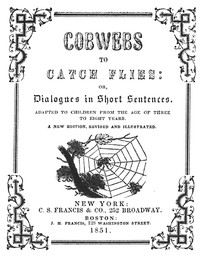
Cobwebs to catch flies : $b or, Dialogues in short sentences adapted to children from the age of three to eight years
Written by Mrs. Lovechild
Chaptra reads alongside you — AI insights, chapter breakdowns and reader discussions for every book. Join free
About this book
Reading guide
Themes, characters and key ideas in Cobwebs to catch flies : $b or, Dialogues in short sentences adapted to children from the age of three to eight years, written by Chaptra AI.
- about 8 hours
- beginner
- instructive
- gentle
- didactic
Mrs. Lovechild's "Cobwebs to Catch Flies" is an early 19th-century children's educational book, structured as a series of simple dialogues aimed at children aged three to eight. Its primary goal is to introduce fundamental concepts, vocabulary, and moral lessons through short, repetitive sentences. The book features children interacting with their environment, discussing nature, animals, and family life, fostering themes of kindness, obedience, and curiosity. Serving as both an entertaining and instructive tool, it was designed to engage young learners and their caregivers in foundational moral and intellectual development. It reflects the didactic approach prevalent in children's literature of its era.
“See the cat. The cat is soft.”
Key themes
- Moral Instruction and Obedience
- A cornerstone of early 19th-century children's literature, this theme emphasizes the importance of good behavior, respect for elders, and adherence to simple societal rules. The dialogues frequently present scenarios where the child learns the value of obedience and the consequences of misbehavior, or the rewards of virtuous actions.
- Vocabulary and Concept Building
- The primary pedagogical goal of the book is to expand a child's vocabulary and introduce fundamental concepts. Each dialogue is meticulously crafted to introduce new words in context, often with repetition, making learning accessible and reinforcing understanding. This theme underpins the entire structure of the book.
- Appreciation and Understanding of Nature
- Many dialogues focus on the natural world, introducing children to animals, plants, and natural phenomena. This theme encourages observation, curiosity, and a basic understanding of the environment. It also subtly instills a sense of wonder and respect for living creatures, linking scientific observation with ethical treatment.
Worth discussing
How does 'Cobwebs to Catch Flies' reflect the educational priorities for children in the early 19th century?
Chapter-by-chapter breakdowns, character arcs and the full thematic analysis come with a free account.
Discussions
No one has started one yet
Questions this book opens up
No discussions yet
Be the first to start a discussion about this book!
Sign up to start the discussionReviews
No reviews yet
Be the first to review this book!