
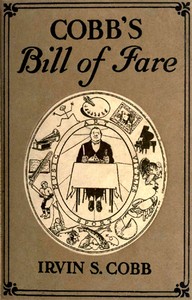
Cobb's Bill-of-Fare
Written by Irvin S. (Irvin Shrewsbury) Cobb
Chaptra reads alongside you — AI insights, chapter breakdowns and reader discussions for every book. Join free
About this book
Read it with a club
Chaptra's ideas and essays clubs — small groups reading the same books and talking as they go.


Books That Changed My Mind
Ideas and essays
- 5 members
- 4 discussions
- Active Sep 11
Not books you enjoyed. Books that moved you off a position you'd genuinely held for years. This is a Chaptra house club — set up and moderated by us to get the conversation going. Open to everyone; jump in anywhere.
Read Cobb's Bill-of-Fare alongside people who are reading it too.
Chaptra Prime — paid clubs, every club feature, and unlimited reading support, for $5 a month or $60 once.
See PrimeReading guide
Themes, characters and key ideas in Cobb's Bill-of-Fare, written by Chaptra AI.
- about 8 hours
- intermediate
- humorous
- nostalgic
- satirical
Irvin S. Cobb's "Cobb's Bill-of-Fare" is a charming collection of early 20th-century essays that humorously dissect various facets of American culture, with a particular emphasis on food, dining experiences, and the author's nostalgic reflections. Through witty anecdotes and keen observations, Cobb captures the spirit of his era, contrasting the simplicity of traditional American fare with the rising tide of culinary pretentiousness. The book opens with a memorable scene of a character yearning for authentic comfort food in a bustling restaurant, setting a satirical yet warm tone for the subsequent explorations of music, art, sports, and the enduring quest for genuine satisfaction in a rapidly changing world. It serves as both a comedic critique and a fond remembrance of American life and its unique cultural palate.
“"There is no greater tragedy than the quest for comfort food in a world bent on culinary pretense."”
Key themes
- Nostalgia for a Simpler Past
- Cobb frequently romanticizes the past, particularly the culinary traditions and cultural straightforwardness of his youth. This theme is explored through his yearning for 'simple and hearty foods' and his reflections on how American life, music, and art have changed. It speaks to a common human desire for comfort and familiarity in an ever-evolving world, and a gentle lament for perceived lost authenticity.
- Critique of Culinary Pretentiousness
- A central and recurring theme is Cobb's humorous yet pointed critique of overly elaborate, fashionable, or inauthentic dining. He champions honest, straightforward food over dishes designed for show rather than substance. This extends beyond food to a broader critique of superficiality in culture.
- American Identity and Culture
- Cobb uses food, music, art, and sports as lenses through which to explore what it means to be American in the early 20th century. His essays, while humorous, implicitly define a certain 'American character' – one that values honesty, practicality, and a certain robust simplicity, often contrasting it with European or more 'refined' sensibilities. It's a celebration, albeit a critical one, of the nation's unique cultural tapestry.
Worth discussing
How does Cobb use humor and satire to critique American culinary trends and broader cultural shifts?
Chapter-by-chapter breakdowns, character arcs and the full thematic analysis come with a free account.
Discussions
No one has started one yet
Questions this book opens up
No discussions yet
Be the first to start a discussion about this book!
Sign up to start the discussionReviews
No reviews yet
Be the first to review this book!