
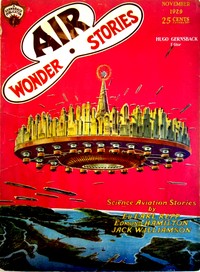
Cities in the air
Written by Edmond Hamilton
Chaptra reads alongside you — AI insights, chapter breakdowns and reader discussions for every book. Join free
About this book
Reading guide
Themes, characters and key ideas in Cities in the air, written by Chaptra AI.
- about 7 hours
- intermediate
- action-packed
- futuristic
- tense
Edmond Hamilton's "Cities in the Air," a late 1920s science fiction novel, envisions a future where humanity resides in colossal airborne metropolises, leaving the Earth largely uninhabited below. The narrative centers on Captain Martin Brant of the American Federation, who finds himself thrust into a desperate aerial conflict against the combined fleets of the European and Asiatic Federations. As Brant's Air-Cruiser 3885 races towards New York amidst news of an imminent attack, the story unfolds with high-stakes battles and a deep exploration of advanced aerial technology. The novel sets the stage for an epic struggle for survival, highlighting a dramatically transformed society reliant on its floating cities.
“"The sky was no longer merely a ceiling; it was the very floor of human civilization, and now, it was a battlefield."”
Key themes
- War and Conflict
- At the core of "Cities in the Air" is the pervasive theme of war and conflict, specifically a grand-scale aerial war between global federations. The novel explores the mechanics of future combat, the strategic imperatives, and the immense human cost, even if depicted through the lens of pulp adventure. It highlights the persistent nature of conflict, even in a radically transformed world, and the drive for dominance or survival that fuels it.
- Technological Advancement and its Consequences
- The novel vividly portrays a future where humanity has achieved monumental technological feats, constructing entire cities in the air. This theme explores both the marvel and the potential peril of such advancement. While it has allowed humanity to escape an uninhabitable Earth, it has also created a new battleground for devastating, high-tech warfare, raising questions about whether progress truly leads to peace or merely shifts the arena of conflict.
- Societal Transformation and Human Adaptation
- The novel presents a dramatic societal transformation where humanity has abandoned the Earth's surface to live exclusively in airborne cities. This theme explores the extent of human adaptability, creating entirely new ways of life, governance, and interaction in a vertical rather than horizontal world. It implicitly questions what aspects of humanity remain constant despite such radical environmental and social shifts.
Worth discussing
How does Hamilton's vision of floating cities reflect the technological optimism and anxieties of the late 1920s?
Chapter-by-chapter breakdowns, character arcs and the full thematic analysis come with a free account.
Discussions
No one has started one yet
Questions this book opens up
No discussions yet
Be the first to start a discussion about this book!
Sign up to start the discussionReviews
No reviews yet
Be the first to review this book!