
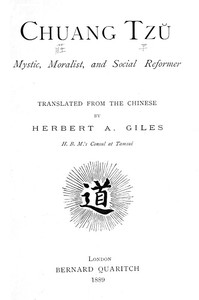
About this book
Reading guide
Themes, characters and key ideas in Chuang Tzu: Mystic, Moralist, and Social Reformer, written by Chaptra AI.
- about 15 hours
- advanced
- Philosophical
- Mysterious
- Humorous
Zhuangzi's eponymous work is a foundational text of Taoist philosophy, challenging conventional wisdom and societal norms through a rich tapestry of allegories, parables, and dialogues. It advocates for transcending fixed perspectives and embracing the relativity of knowledge, encouraging readers to find liberation in spontaneity and naturalness. The text critiques the materialistic and rigid approaches of Confucianism, urging a deeper understanding of life where freedom emerges from aligning with the inherent mysteries and vastness of existence. Through vivid metaphors and humorous anecdotes, Zhuangzi guides the reader towards a profound, non-dualistic appreciation of the universe, fostering a philosophy of 'free and easy wandering' beyond human-made distinctions.
“"The little understands the great, and the small cannot grasp the vast."”
Key themes
- Relativity of Knowledge and Perspective
- This is a cornerstone of Zhuangzi's philosophy. He argues that all human distinctions and judgments (e.g., good/bad, large/small, beautiful/ugly) are relative to one's perspective and context. There is no absolute truth or fixed reality, only interpretations. This theme encourages a liberation from dogmatic thinking and an embrace of multiple viewpoints.
- Spontaneity and Naturalness (Ziran)
- Zhuangzi advocates for living in accordance with one's authentic nature and the spontaneous flow of the universe, rather than being constrained by artificial rules, societal expectations, or deliberate efforts. 'Ziran' means 'self-so' or 'naturalness,' emphasizing effortless action and a lack of forced intention (wu wei).
- Critique of Conventionalism and Artificiality
- Zhuangzi consistently challenges the artificial distinctions, moral codes, and social hierarchies imposed by human society, particularly those championed by Confucianism. He argues that these man-made constructs lead to suffering, conflict, and a departure from one's true nature. He exposes the folly of seeking fame, power, or wealth.
Worth discussing
How does Zhuangzi's concept of 'relativity' challenge our everyday understanding of truth and reality?
Chapter-by-chapter breakdowns, character arcs and the full thematic analysis come with a free account.
Discussions
No one has started one yet
Questions this book opens up
No discussions yet
Be the first to start a discussion about this book!
Sign up to start the discussionReviews
No reviews yet
Be the first to review this book!