
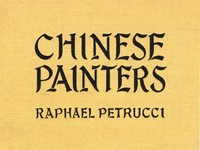
Chinese Painters: A Critical Study
Written by Raphaël Petrucci
Chaptra reads alongside you — AI insights, chapter breakdowns and reader discussions for every book. Join free
About this book
Reading guide
Themes, characters and key ideas in Chinese Painters: A Critical Study, written by Chaptra AI.
- about 15 hours
- advanced
- Informative
- Scholarly
- Analytical
Raphaël Petrucci's "Chinese Painters: A Critical Study" is an early 20th-century foundational text that critically explores the rich history, philosophical underpinnings, and unique techniques of Chinese painting. The book advocates for a distinct approach to appreciating Chinese art, urging readers to move beyond Western aesthetic biases and engage deeply with its cultural heritage. Petrucci meticulously examines mediums like silk and paper, highlights the paramount importance of brush technique, and elucidates the intrinsic connection between Chinese calligraphy and pictorial art. It provides a structured outline of the evolution of Chinese styles, paving the way for a nuanced discussion of influential artists and artistic movements. This work serves as an essential resource for art enthusiasts and scholars seeking a comprehensive understanding of Chinese artistic traditions.
“To truly comprehend Chinese painting, one must first abandon Western aesthetic preconceptions and embrace its distinct cultural lexicon.”
Key themes
- Cross-cultural Artistic Understanding
- The central theme revolves around the necessity and challenge of appreciating Chinese art on its own terms, advocating for a shift from Western-centric aesthetic paradigms. Petrucci aims to build a bridge of understanding, urging readers to immerse themselves in the distinct cultural and philosophical context of Chinese art to truly grasp its essence.
- The Interrelation of Calligraphy and Painting
- This theme explores the fundamental and inseparable connection between Chinese writing (calligraphy) and visual art. Petrucci argues that brush technique, line quality, and the ideographic nature of Chinese characters are not merely stylistic choices but are deeply embedded in the artistic expression and philosophical meaning of Chinese painting.
- Philosophical Underpinnings of Chinese Art
- Petrucci delves into the conceptual and philosophical foundations that inform Chinese painting, moving beyond mere surface aesthetics to explore the deeper meanings, worldviews, and spiritual dimensions embedded in the art. This includes implicit references to Daoist, Buddhist, and Confucian influences, which shape artistic goals and interpretations.
Worth discussing
How does Petrucci's early 20th-century Western perspective influence his interpretation of Chinese art, and what are its strengths and limitations?
Chapter-by-chapter breakdowns, character arcs and the full thematic analysis come with a free account.
Discussions
No one has started one yet
Questions this book opens up
No discussions yet
Be the first to start a discussion about this book!
Sign up to start the discussionReviews
No reviews yet
Be the first to review this book!