
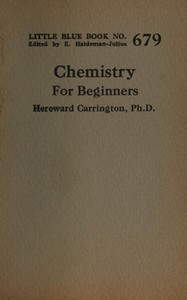
Chemistry for beginners
Written by Hereward Carrington
Chaptra reads alongside you — AI insights, chapter breakdowns and reader discussions for every book. Join free
About this book
Reading guide
Themes, characters and key ideas in Chemistry for beginners, written by Chaptra AI.
- about 10 hours
- beginner
- Informative
- Educational
- Analytical
Hereward Carrington's "Chemistry for Beginners," an early 20th-century scientific publication, offers an accessible introduction to chemistry, tracing its evolution from ancient alchemy to contemporary scientific understanding. The book comprehensively covers foundational principles like atomic theory and the periodic law, alongside historical insights into key scientific figures. Structured in two parts, it progresses from historical context and basic concepts to detailed examinations of individual elements, organic/inorganic compounds, and advanced topics such as radioactivity and the origins of life. Carrington masterfully blends rigorous scientific inquiry with philosophical reflections, providing a holistic view of the material world for novice learners.
“From the alchemist's crucible to the spectroscopist's prism, the quest to understand matter has shaped human civilization.”
Key themes
- Scientific Progress and Evolution
- The book fundamentally explores chemistry as a dynamic field, showcasing its evolution from rudimentary ancient alchemy to sophisticated early 20th-century scientific understanding. It highlights how theories are refined, replaced, and built upon, emphasizing the iterative nature of scientific discovery and human intellectual advancement through historical context.
- The Nature of Matter and Energy
- At its core, the book investigates the fundamental composition and behavior of matter. It delves into atomic theory, the properties of elements, and the interactions that form compounds, ultimately exploring the energy inherent within and between these structures, including the then-revolutionary concept of intra-atomic energy.
- The Interplay of Science and Philosophy
- Carrington explicitly blends scientific inquiry with "philosophical reflections on the nature of matter" and "the origins of life." This theme explores how scientific findings prompt deeper existential and ontological questions, and how philosophical frameworks can influence or be influenced by scientific understanding, elevating the text beyond a mere collection of facts.
Worth discussing
How does understanding the historical development of chemistry, from alchemy to modern science, impact our appreciation of current scientific knowledge?
Chapter-by-chapter breakdowns, character arcs and the full thematic analysis come with a free account.
Discussions
No one has started one yet
Questions this book opens up
No discussions yet
Be the first to start a discussion about this book!
Sign up to start the discussionReviews
No reviews yet
Be the first to review this book!