
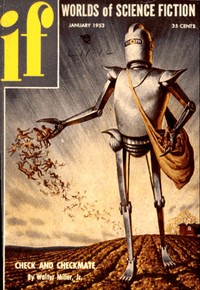
Check and Checkmate
Written by Walter M. Miller
Chaptra reads alongside you — AI insights, chapter breakdowns and reader discussions for every book. Join free
About this book
Reading guide
Themes, characters and key ideas in Check and Checkmate, written by Chaptra AI.
- about 8 hours
- intermediate
- Dystopian
- Tense
- Political
Walter M. Miller, Jr.'s novella "Check and Checkmate" plunges into a Cold War-era dystopian future where John Smith XVI, President of the Western Federation, grapples with political isolation and an artificial communication barrier with the Eastern powers. His attempts to forge diplomacy with Ivan Ivanovitch IX, leader of the Asian Proletarian League, expose a labyrinth of espionage and manipulation. Both leaders discover they are pawns in a larger game, trapped by systems designed to betray them and influenced by unseen external forces. The narrative culminates in a tense confrontation, revealing the precariousness of their identities and the relentless, often absurd, nature of political conflict and governance.
“"In a world built on walls, the first casualty is always truth, followed closely by trust."”
Key themes
- Political Isolation & Communication Breakdown
- This theme is central to the novella, manifested by the 'artificial communication barrier' between the Western Federation and the Asian Proletarian League. Miller explores how deliberate isolation and the breakdown of genuine communication foster mistrust, paranoia, and the perpetuation of conflict. The barrier is not just physical but psychological, preventing understanding and human connection, thus making diplomacy nearly impossible and increasing the likelihood of miscalculation and escalation.
- Espionage & Subterfuge
- The narrative is steeped in a culture of espionage, where covert operations, double agents, and hidden agendas are the norm. This theme highlights the corrosive effect of constant suspicion on trust and genuine human interaction. It underscores how subterfuge becomes not just a tool of statecraft but an intrinsic part of the social and political fabric, blurring the lines between friend and foe, truth and deception, and ultimately leading to the manipulation of leaders themselves.
- Leadership & Manipulation
- Miller critically examines the nature of leadership, particularly in a dystopian context. Both John Smith XVI and Ivan Ivanovitch IX are depicted not as omnipotent rulers but as figures manipulated by larger, unseen forces or 'the system' itself. This theme challenges the traditional view of leaders as autonomous agents, suggesting they are often pawns in a grander game, constrained by their roles and the expectations of their positions. It explores the psychological toll of such a precarious existence and the illusion of control.
Worth discussing
How does the 'artificial communication barrier' symbolize real-world political obstacles and propaganda during the Cold War?
Chapter-by-chapter breakdowns, character arcs and the full thematic analysis come with a free account.
Discussions
No one has started one yet
Questions this book opens up
No discussions yet
Be the first to start a discussion about this book!
Sign up to start the discussionReviews
No reviews yet
Be the first to review this book!