
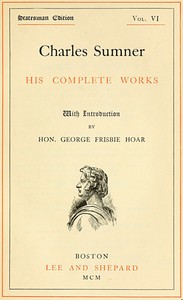
Charles Sumner: his complete works, volume 06 (of 20)
Written by Charles Sumner
Chaptra reads alongside you — AI insights, chapter breakdowns and reader discussions for every book. Join free
About this book
Reading guide
Themes, characters and key ideas in Charles Sumner: his complete works, volume 06 (of 20), written by Chaptra AI.
- about 15 hours
- advanced
- serious
- historical
- passionate
This sixth volume of Charles Sumner's complete works compiles his pivotal letters and speeches from the mid-19th century, chronicling his fervent abolitionist efforts leading up to the American Civil War. As a U.S. Senator and staunch Republican, Sumner vehemently advocates against the expansion of slavery, particularly in Kansas, urging political unity and action. The collection reveals his unwavering commitment to public duty despite personal health struggles, inspiring citizens, especially the youth of Massachusetts, to join the fight for liberty. It serves as a vital primary source for understanding the charged political landscape and the moral imperatives driving the anti-slavery movement during a critical period in American history.
“The crime against Kansas is not a local outrage, but a national atrocity.”
Key themes
- Abolitionism and Anti-Slavery
- This is the central theme, explored through Sumner's relentless opposition to slavery's expansion and his moral condemnation of the institution itself. He argues for the fundamental human right to liberty and challenges the legal and social structures that uphold slavery, particularly in the context of Kansas.
- Political Activism and Duty
- The volume showcases Sumner's deep sense of civic duty and his belief in the power of political action to effect social change. Despite personal health issues, he consistently expresses his commitment to public service and rallies others to participate in the political process, particularly within the Republican Party.
- Justice and the Rule of Law
- Sumner frequently invokes principles of justice and the rule of law to bolster his arguments against slavery. He frames the expansion of slavery as a violation of both natural law and constitutional principles, advocating for a legal framework that upholds freedom and equality.
Worth discussing
How does Sumner's rhetoric reflect the political and social climate of the mid-19th century?
Chapter-by-chapter breakdowns, character arcs and the full thematic analysis come with a free account.
Discussions
No one has started one yet
Questions this book opens up
No discussions yet
Be the first to start a discussion about this book!
Sign up to start the discussionReviews
No reviews yet
Be the first to review this book!