
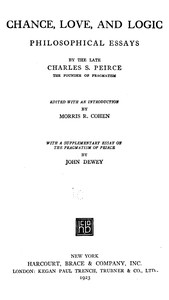
Chance, Love, and Logic: Philosophical Essays
Written by Charles S. (Charles Sanders) Peirce
Chaptra reads alongside you — AI insights, chapter breakdowns and reader discussions for every book. Join free
About this book
Reading guide
Themes, characters and key ideas in Chance, Love, and Logic: Philosophical Essays, written by Chaptra AI.
- about 15 hours
- advanced
- analytical
- philosophical
- intellectual
Charles S. Peirce's "Chance, Love, and Logic" is a seminal collection of philosophical essays that introduces and elaborates on his groundbreaking ideas, particularly those that form the bedrock of pragmatism. The work meticulously explores the nature of scientific inquiry, the formation and fixation of belief, and the logical processes underpinning knowledge acquisition. Peirce critiques traditional dogmatic approaches, advocating for a rigorous, community-driven scientific method that embraces fallibilism and the continuous evolution of thought. It highlights the profound interconnectedness of chance, the role of altruistic 'love' (agapism) in cosmic evolution, and the necessity of clear reasoning for understanding reality. This collection serves as a foundational text for understanding Peirce's unique contributions to logic, metaphysics, and the philosophy of science.
“The opinion which is fated to be ultimately agreed to by all who investigate, is what we mean by the truth, and the object represented in this opinion is the real.”
Key themes
- Pragmatism and the Logic of Inquiry
- This theme explores Peirce's foundational contributions to pragmatism, emphasizing the practical consequences of ideas as their meaning. It delves into his systematic approach to inquiry, moving from the irritation of doubt to the fixation of belief through scientific method, rather than tenacity, authority, or *a priori* reasoning. He posits that the meaning of a concept is exhausted by its conceivable practical effects, providing a powerful tool for clarifying ambiguous ideas.
- Tychism (Absolute Chance)
- Peirce's doctrine of tychism posits that absolute chance, spontaneity, and indeterminacy are fundamental features of the universe, not merely a reflection of human ignorance. This challenges deterministic worldviews prevalent in 19th-century science, suggesting that genuine novelty and variation arise from inherent lawlessness at a foundational level, providing the raw material for evolution and growth.
- Fallibilism and the Community of Inquiry
- Peirce's fallibilism asserts that all human knowledge is inherently imperfect and subject to revision; no belief is absolutely certain. This humility about knowledge is paired with the concept of the 'community of inquiry,' which holds that truth is what an indefinite community of inquirers would ultimately agree upon, given sufficient time and evidence. This communal aspect emphasizes the social and collaborative nature of scientific and philosophical progress.
Worth discussing
How does Peirce's 'fixation of belief' critique traditional methods of inquiry, and what are the implications for modern discourse?
Chapter-by-chapter breakdowns, character arcs and the full thematic analysis come with a free account.
Discussions
No one has started one yet
Questions this book opens up
No discussions yet
Be the first to start a discussion about this book!
Sign up to start the discussionReviews
No reviews yet
Be the first to review this book!