
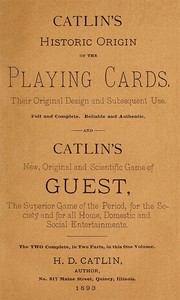
Catlin's historic origin of the playing cards : $b Their original design and subsequent use
Written by H. D. (Homer D.) Catlin
Chaptra reads alongside you — AI insights, chapter breakdowns and reader discussions for every book. Join free
About this book
Reading guide
Themes, characters and key ideas in Catlin's historic origin of the playing cards : $b Their original design and subsequent use, written by Chaptra AI.
- about 8 hours
- intermediate
- Informative
- Historical
- Didactic
H. D. Catlin's "Catlin's historic origin of the playing cards" is a late 19th-century historical treatise positing an ancient Egyptian origin for playing cards, tracing their evolution through various cultures. The author speculates that cards initially represented significant numerical and temporal concepts derived from hieroglyphics, such as seasons and months. Beyond this historical exploration, Catlin introduces his own scientifically designed card game, "Guest," which he claims superior to popular games like Whist and Euchre by offering a balanced and structured gameplay experience. Throughout the work, Catlin advocates for the positive, morally uplifting potential of playing cards, emphasizing their role in both social entertainment and contemplative thought. It serves as both a historical inquiry and a prescriptive guide for card play.
“The origin of playing cards is not shrouded in impenetrable mystery, but lies clearly decipherable in the ancient hieroglyphics of Egypt.”
Key themes
- Origins and Evolution of Cultural Artifacts
- The central theme of the book is Catlin's investigation into the purported ancient origins of playing cards, tracing their evolution from Egyptian hieroglyphics through various cultures to their modern forms. He attempts to provide a comprehensive, albeit speculative, historical narrative for a seemingly common object, imbuing it with deep historical and symbolic significance.
- Innovation and Systematization of Leisure
- Catlin not only explores the history of playing cards but also actively contributes to their evolution by inventing and meticulously detailing his own game, 'Guest.' This reflects a broader Victorian-era impulse to rationalize, improve, and even 'scientifically' develop leisure activities, aiming for more balanced, intellectual, and perhaps morally upright forms of entertainment.
- The Moral and Social Purpose of Entertainment
- Catlin frequently emphasizes the potential of playing cards for 'social entertainment and moral contemplation,' urging players to use them in 'positive, uplifting ways.' This reflects a Victorian concern with the moral implications of leisure activities and a desire to elevate popular pastimes beyond mere frivolous diversion, aligning them with intellectual and ethical development.
Worth discussing
To what extent do Catlin's historical claims about the Egyptian origin of playing cards hold up against modern archaeological and historical evidence? What are the implications of such speculative history?
Chapter-by-chapter breakdowns, character arcs and the full thematic analysis come with a free account.
Discussions
No one has started one yet
Questions this book opens up
No discussions yet
Be the first to start a discussion about this book!
Sign up to start the discussionReviews
No reviews yet
Be the first to review this book!