
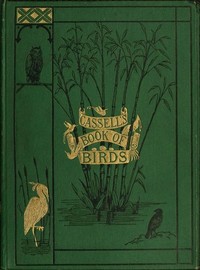
Cassell's book of birds; vol. 4
Written by Alfred Edmund Brehm
Chaptra reads alongside you — AI insights, chapter breakdowns and reader discussions for every book. Join free
About this book
Reading guide
Themes, characters and key ideas in Cassell's book of birds; vol. 4, written by Chaptra AI.
- about 25 hours
- advanced
- Informative
- Descriptive
- Scientific
Cassell's Book of Birds; Vol. 4 by Alfred Edmund Brehm is a monumental late 19th-century scientific treatise dedicated to the detailed study of various avian families, including stilt-walkers, bustards, and plovers. This volume systematically presents extensive information on bird characteristics, habitats, and behaviors, richly augmented by colored plates and engravings. Brehm meticulously explores the vast diversity and global presence of these species, highlighting their unique adaptations for survival across diverse environments. Serving as a foundational resource for ornithology, the work masterfully combines rigorous scientific observation with artistic presentation, appealing to both academic scholars and enthusiastic naturalists.
“The stilt-walkers, with their remarkable elongated limbs, present a fascinating study in adaptation, perfectly equipped for navigating shallow waters in pursuit of sustenance.”
Key themes
- Biodiversity and Classification
- The core of the book is documenting the vast array of bird species and organizing them into families based on observable characteristics. It highlights the scientific endeavor to categorize and understand the natural world, reflecting the systematic approach of 19th-century natural history.
- Adaptation and Natural Selection (Proto-Evolutionary Thought)
- While pre-dating the full acceptance and understanding of Darwinian evolution, the book meticulously describes how birds' physical traits (e.g., long legs of stilt-walkers, camouflage of bustards) are perfectly suited to their specific environments and lifestyles, implicitly demonstrating principles of adaptation and the efficiency of natural design.
- Human Observation and Documentation of Nature
- The book itself is a monument to human curiosity and the systematic effort to observe, record, and disseminate knowledge about the natural world. It reflects the scientific methodology of its time, emphasizing empirical data collection and detailed reporting as crucial to understanding nature.
Worth discussing
How does Brehm's approach to classification compare to modern phylogenetic methods?
Chapter-by-chapter breakdowns, character arcs and the full thematic analysis come with a free account.
Discussions
No one has started one yet
Questions this book opens up
No discussions yet
Be the first to start a discussion about this book!
Sign up to start the discussionReviews
No reviews yet
Be the first to review this book!