
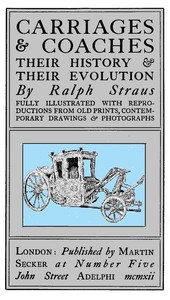
Carriages & Coaches: Their History & Their Evolution
Written by Ralph Straus
Chaptra reads alongside you — AI insights, chapter breakdowns and reader discussions for every book. Join free
About this book
Reading guide
Themes, characters and key ideas in Carriages & Coaches: Their History & Their Evolution, written by Chaptra AI.
- about 8 hours
- intermediate
- Informative
- Historical
- Detailed
Ralph Straus's "Carriages & Coaches: Their History & Their Evolution" offers a comprehensive early 20th-century historical exploration of wheeled vehicles, tracing their development from rudimentary designs to the sophisticated carriages and coaches of later eras. The book meticulously details the origins of the wheel and early transport methods like sledges, illustrating how these foundational innovations profoundly impacted human movement and commerce. Straus aims for accessibility, providing a non-technical narrative that bridges engineering advancements with their broader social implications. It serves as a foundational text for understanding the intricate relationship between technological progress in transportation and societal evolution over centuries.
“The story of the carriage is, in essence, the story of man's ceaseless quest for greater mobility and comfort.”
Key themes
- Technological Evolution and Innovation
- This theme explores the continuous development and refinement of wheeled vehicles, from basic sledges and early wheels to complex carriages with sophisticated suspension systems. It highlights human ingenuity in addressing practical challenges of transport and comfort through design and engineering advancements.
- Social Transformation through Transport
- The book meticulously details how advancements in carriages and coaches were not merely mechanical but deeply interwoven with societal changes. It explores how these vehicles influenced social mobility, economic activity, urban development, and the stratification of society.
- Historical Context and Progress
- Straus emphasizes understanding the development of carriages within their specific historical and cultural contexts. The book underscores that each innovation was a response to the materials, knowledge, and needs of its era, demonstrating a clear trajectory of progress over centuries.
Worth discussing
How did the invention of the wheel fundamentally alter human societies, beyond just transportation?
Chapter-by-chapter breakdowns, character arcs and the full thematic analysis come with a free account.
Discussions
No one has started one yet
Questions this book opens up
No discussions yet
Be the first to start a discussion about this book!
Sign up to start the discussionReviews
No reviews yet
Be the first to review this book!