
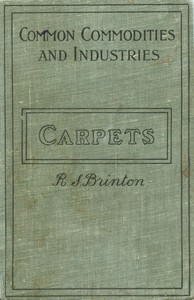
Carpets
Written by R. S. (Reginald Seymour) Brinton
Chaptra reads alongside you — AI insights, chapter breakdowns and reader discussions for every book. Join free
About this book
Read it with a club
Small groups reading the same books and talking as they go.


News
- 4 members
- 1,813 discussions
- Active Sep 11
Read Carpets alongside people who are reading it too.
Also here: News Bulletin, Just Joking....
Chaptra Prime — paid clubs, every club feature, and unlimited reading support, for $5 a month or $60 once.
See PrimeReading guide
Themes, characters and key ideas in Carpets, written by Chaptra AI.
- about 8 hours
- intermediate
- informative
- historical
- detailed
R. S. Brinton's "Carpets" is an early 20th-century technical treatise offering an exhaustive exploration of carpet manufacturing. It systematically traces the craft's history from ancient origins, detailing the evolution of weaving techniques, and the transformative introduction of mechanical looms. The work serves as a vital resource for both industry professionals and general enthusiasts, aiming to demystify complex mechanical processes for a broader audience. Brinton's comprehensive approach covers materials, methods, and styles, establishing it as a foundational text in the study of carpet production.
“"The history of carpets is inextricably woven with the very fabric of human civilization, reflecting shifts in culture, technology, and artistic expression."”
Key themes
- Industrial Evolution and Mechanization
- This theme explores the profound impact of technological advancements, particularly the introduction of mechanical looms, on the traditional craft of carpet making. Brinton meticulously details how these innovations transformed production methods, increased output, and reshaped the industry from artisanal workshops to industrial factories. It highlights the shift from labor-intensive, hand-crafted techniques to more efficient, machine-driven processes.
- The Preservation of Craft and Knowledge
- Brinton's work itself embodies the theme of preserving knowledge. By documenting the history, techniques, and materials of carpet manufacturing, the book ensures that intricate details of a complex craft are recorded for future generations. It reflects an effort to prevent the loss of traditional methods while also contextualizing modern advancements within a rich historical lineage. The acknowledgment of contemporaries further emphasizes the collective effort in knowledge sharing.
- Materials Science and Application
- A fundamental aspect of carpet manufacturing is the understanding and application of various materials. This theme delves into the properties, sourcing, and processing of fibers used in carpets, such as wool, cotton, silk, and potentially early synthetics. Brinton likely explains how different materials affect durability, texture, appearance, and cost, linking material choice directly to manufacturing techniques and the final product's quality and marketability.
Worth discussing
How does Brinton's work illuminate the transition from traditional craftsmanship to industrial-scale manufacturing in the early 20th century?
Chapter-by-chapter breakdowns, character arcs and the full thematic analysis come with a free account.
Discussions
No one has started one yet
Questions this book opens up
No discussions yet
Be the first to start a discussion about this book!
Sign up to start the discussionReviews
No reviews yet
Be the first to review this book!