
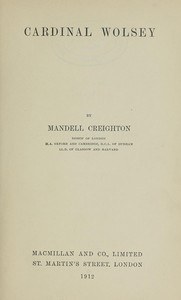
Cardinal Wolsey
Written by M. (Mandell) Creighton
Chaptra reads alongside you — AI insights, chapter breakdowns and reader discussions for every book. Join free
About this book
Reading guide
Themes, characters and key ideas in Cardinal Wolsey, written by Chaptra AI.
- about 10 hours
- advanced
- Historical
- Analytical
- Intriguing
Mandell Creighton's "Cardinal Wolsey" offers a late 19th-century historical examination of Thomas Wolsey, the influential statesman and cardinal during Henry VIII's reign. The book meticulously details Wolsey's pivotal role in early 16th-century European politics, highlighting his unparalleled diplomatic prowess and strategic foreign policy decisions. It explores how Wolsey significantly elevated England's standing on the international stage amidst the decline of the medieval state system and the rise of new political dynamics. Creighton's narrative underscores Wolsey's unique ability to navigate complex alliances and power struggles, ultimately shaping the course of English history through his ambitious and often underappreciated contributions.
“The tapestry of European diplomacy was woven with threads of shifting alliances and calculated betrayals, a landscape Wolsey navigated with unparalleled mastery.”
Key themes
- Power and Ambition
- This theme is central to understanding Wolsey's entire career. The book explores how Wolsey's insatiable ambition fueled his rise to unprecedented power, both within the Church and the English state. It also examines the nature of power itself in the early modern period – how it was acquired, maintained, and ultimately lost, often through a delicate balance of royal favor, political maneuvering, and international diplomacy. The narrative implicitly questions the morality and consequences of such vast personal ambition.
- Diplomacy and Statecraft
- Creighton presents Wolsey as a master of diplomacy, whose strategic genius in foreign affairs was crucial to England's rise on the European stage. The book meticulously details the complex diplomatic dances between England, France, the Holy Roman Empire, and the Papacy, illustrating the intricate negotiations, alliances, and betrayals that characterized 16th-century international relations. It highlights Wolsey's innovative use of diplomacy to achieve a balance of power and assert England's influence without vast military expenditure.
- The Role of the Individual in History
- The book strongly emphasizes Wolsey's singular impact on English and European history. It argues that his intelligence, strategic vision, and diplomatic abilities were unique among his contemporaries, allowing him to shape events in a way few individuals could. This theme explores the extent to which a single, exceptionally talented person can alter the course of national and international affairs, rather than merely being a product of their time. Wolsey is portrayed as a prime mover, not just a reactor.
Worth discussing
To what extent was Wolsey a self-serving opportunist versus a dedicated servant of the Crown and England's interests?
Chapter-by-chapter breakdowns, character arcs and the full thematic analysis come with a free account.
Discussions
No one has started one yet
Questions this book opens up
No discussions yet
Be the first to start a discussion about this book!
Sign up to start the discussionReviews
No reviews yet
Be the first to review this book!