
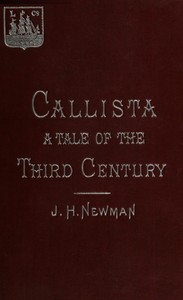
Callista : a Tale of the Third Century
Written by John Henry Newman
Chaptra reads alongside you — AI insights, chapter breakdowns and reader discussions for every book. Join free
About this book
Reading guide
Themes, characters and key ideas in Callista : a Tale of the Third Century, written by Chaptra AI.
- about 10 hours
- advanced
- serious
- contemplative
- spiritual
John Henry Newman's "Callista: A Tale of the Third Century" is a historical novel set in Roman North Africa during the Decian persecutions. It intricately explores the spiritual journey of Callista, a talented pagan sculptor, as she grapples with the emptiness of paganism and the profound truth of Christianity. Through her interactions with a conflicted young Christian named Agellius and various other characters, Newman illuminates the clash between the decadent Roman world and the burgeoning, persecuted Christian faith. The narrative culminates in Callista's conversion and eventual martyrdom, serving as an apologetic work that showcases the logical and emotional draw of early Christianity amidst a hostile empire.
“"The heart is a sanctuary, which the world may not profane, but which it may tempt." (Paraphrased, reflecting Newman's focus on inner life and temptation)”
Key themes
- Faith vs. Paganism/Atheism
- The central theme of the novel, exploring the fundamental differences between the polytheistic, often superstitious, and morally ambiguous world of paganism, and the monotheistic, ethically demanding, and spiritually fulfilling nature of Christianity. Newman argues for the intellectual and moral superiority of Christianity.
- Martyrdom and Suffering
- The novel portrays martyrdom not as a tragic end, but as the ultimate act of faith, a testament to divine truth, and a means of spiritual purification and triumph. It highlights the courage of early Christians in the face of persecution and the transformative power of suffering for one's beliefs.
- Conversion and Spiritual Journey
- The novel meticulously charts the internal and external processes of conversion, particularly through Callista's experience. It shows how intellectual doubt, moral conviction, and divine grace interact to lead an individual from one belief system to another, emphasizing the personal and often arduous nature of such a journey.
Worth discussing
How does Newman portray the spiritual emptiness of paganism compared to the fullness of Christian faith?
Chapter-by-chapter breakdowns, character arcs and the full thematic analysis come with a free account.
Discussions
No one has started one yet
Questions this book opens up
No discussions yet
Be the first to start a discussion about this book!
Sign up to start the discussionReviews
No reviews yet
Be the first to review this book!