
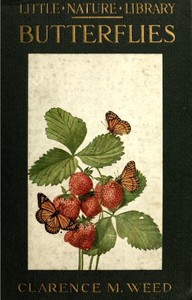
Butterflies Worth Knowing
Written by Clarence Moores Weed
Chaptra reads alongside you — AI insights, chapter breakdowns and reader discussions for every book. Join free
About this book
Reading guide
Themes, characters and key ideas in Butterflies Worth Knowing, written by Chaptra AI.
- about 8 hours
- intermediate
- informative
- educational
- appreciative
Clarence Moores Weed's "Butterflies Worth Knowing" is an early 20th-century scientific publication dedicated to the diverse butterfly species of eastern North America. The book meticulously explores the life histories and ecological interactions of these insects, serving as an invaluable educational resource. It aims to foster a foundational understanding of butterfly biology, from their anatomical features and life cycles to their captivating transformations. Through detailed observation and study, Weed invites nature enthusiasts and students to appreciate the delicate structure and vibrant colors of these beautiful creatures, building upon the contributions of past researchers in the field.
“Weed emphasizes the importance of observation and study in understanding these beautiful insects.”
Key themes
- Scientific Observation and Inquiry
- This theme is central to the book's purpose. Weed consistently emphasizes the importance of direct observation and meticulous study as the foundation for understanding the natural world. It promotes an empirical approach to science, encouraging readers to engage actively with their environment.
- Education and Public Engagement with Science
- The book explicitly serves as an 'educational tool for nature enthusiasts and students.' It aims to disseminate scientific knowledge in an accessible format, bridging the gap between academic research and public understanding, thereby promoting scientific literacy.
- Biodiversity and Ecological Interconnectedness
- The book investigates 'diverse butterfly species' and their 'ecological interactions,' highlighting the variety of life forms within a specific region and how they relate to their environment and each other. It subtly introduces the concept of an ecosystem where each species plays a role.
Worth discussing
How has our scientific understanding of butterfly life cycles and ecological interactions evolved since Clarence Moores Weed's time?
Chapter-by-chapter breakdowns, character arcs and the full thematic analysis come with a free account.
Discussions
No one has started one yet
Questions this book opens up
No discussions yet
Be the first to start a discussion about this book!
Sign up to start the discussionReviews
No reviews yet
Be the first to review this book!