
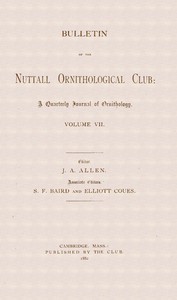
Bulletin of the Nuttall Ornithological Club : $b A quarterly journal of ornithology, Volume VII (1882)
Written by Nuttall Ornithological Club
Chaptra reads alongside you — AI insights, chapter breakdowns and reader discussions for every book. Join free
About this book
Reading guide
Themes, characters and key ideas in Bulletin of the Nuttall Ornithological Club : $b A quarterly journal of ornithology, Volume VII (1882), written by Chaptra AI.
- about 15 hours
- advanced
- Informative
- Empirical
- Analytical
The "Bulletin of the Nuttall Ornithological Club, Volume VII (1882)" is a seminal scientific journal representing the state of ornithological research in North America during the late 19th century. Published quarterly, it served as a vital forum for naturalists and scientists to disseminate findings on avian taxonomy, distribution, migration patterns, and life histories. This volume compiles a diverse range of articles, field notes, and critical reviews, reflecting the meticulous observational and descriptive methodologies prevalent in the era. It stands as a crucial historical document illustrating the foundational work that shaped modern ornithology and conservation efforts.
“"The occurrence of *Plectrophanes hyperboreus* in Alaska provides further evidence of its circumpolar distribution, challenging previous notions of its restricted range."”
Key themes
- Taxonomy and Systematics
- A central theme is the meticulous classification, description, and naming of bird species and subspecies. Articles often focus on identifying new taxa, resolving taxonomic ambiguities, or revising existing classifications based on morphological comparisons and geographic distribution.
- Geographic Distribution and Migration
- The journal dedicates significant attention to documenting where different bird species are found, their range expansions or contractions, and the patterns of their seasonal migrations. This involves extensive field observations and compilation of records from various localities.
- Field Observation and Data Collection
- Emphasizes the importance of direct observation in natural habitats, meticulous record-keeping, and the collection of specimens. The articles showcase the descriptive power of 19th-century naturalists and their dedication to empirical evidence.
Worth discussing
How did the methodologies employed in 1882, relying heavily on observation and specimen collection, differ from modern ornithological research techniques?
Chapter-by-chapter breakdowns, character arcs and the full thematic analysis come with a free account.
Discussions
No one has started one yet
Questions this book opens up
No discussions yet
Be the first to start a discussion about this book!
Sign up to start the discussionReviews
No reviews yet
Be the first to review this book!