
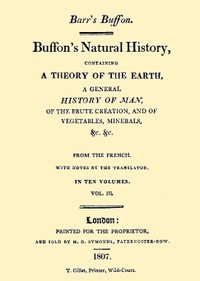
Buffon's Natural History, Volume 03 (of 10): Containing a Theory of the Earth, a General History of Man, of the Brute Creation, and of Vegetables, Minerals, &c. &c.
Written by Georges Louis Leclerc Buffon
Chaptra reads alongside you — AI insights, chapter breakdowns and reader discussions for every book. Join free
About this book
Read it with a club
Chaptra's history and war clubs — small groups reading the same books and talking as they go.


Footnotes & Firefights
History and war
- 4 members
- 4 discussions
- Active 2d ago
Military history, from grand strategy down to the deeply boring logistics that actually decided everything. This is a Chaptra house club — set up and moderated by us to get the conversation going. Open to everyone; jump in anywhere.
Read Buffon's Natural History, Volume 03 (of 10): Containing a Theory of the Earth, a General History of Man, of the Brute Creation, and of Vegetables, Minerals, &c. &c. alongside people who are reading it too.
Also here: Empire, Reconsidered
Chaptra Prime — paid clubs, every club feature, and unlimited reading support, for $5 a month or $60 once.
See PrimeReading guide
Themes, characters and key ideas in Buffon's Natural History, Volume 03 (of 10): Containing a Theory of the Earth, a General History of Man, of the Brute Creation, and of Vegetables, Minerals, &c. &c., written by Chaptra AI.
- about 15 hours
- advanced
- scholarly
- analytical
- speculative
Buffon's Natural History, Volume 03, presents the foundational 'Theory of the Earth,' a groundbreaking attempt to explain the planet's formation and geological evolution through natural laws rather than strictly biblical chronology. This volume establishes the cosmic and terrestrial framework for the subsequent natural histories of living beings, proposing a vast timeline for Earth's development and challenging prevailing scientific and religious dogmas of the 18th century. It marks a pivotal moment in the Enlightenment, blending meticulous observation with speculative reasoning to construct a comprehensive, albeit pre-Darwinian, understanding of nature. Buffon sets the stage for his encyclopedic project by detailing the forces that shaped the globe and its surface features.
“The most important truths are those which are most general; and the most general truths are those which are most simple.”
Key themes
- The Vastness of Geological Time
- Buffon's most radical contribution in this volume is the concept of 'deep time.' He systematically argues for an Earth far older than the few thousand years derived from biblical chronology, proposing a multi-epoch theory of millions of years for the planet's formation and geological evolution. This theme challenges anthropocentric views of history and establishes a new, vast temporal scale for understanding natural processes.
- Naturalistic Explanations vs. Divine Intervention
- Buffon's 'Theory of the Earth' is a deliberate attempt to explain natural phenomena through natural laws and processes, rather than solely relying on supernatural or catastrophic divine interventions. While not an atheist, he sought to remove God from the day-to-day operation of the universe, focusing on observable causes and effects. This theme represents a key shift in scientific thought during the Enlightenment.
- The Unity and Interconnectedness of Nature
- Buffon's ambition to create a comprehensive 'Natural History' speaks to his belief in the underlying unity and interconnectedness of all natural phenomena. This volume, by establishing a single origin and set of physical laws for the Earth, sets the stage for understanding how geology, climate, and ultimately life, are all part of a single, grand system. He seeks to reveal the 'system of the universe' through detailed observation and synthesis.
Worth discussing
How did Buffon's 'Theory of the Earth' challenge prevailing scientific and religious views of his time, and what were the consequences?
Chapter-by-chapter breakdowns, character arcs and the full thematic analysis come with a free account.
Discussions
No one has started one yet
Questions this book opens up
No discussions yet
Be the first to start a discussion about this book!
Sign up to start the discussionReviews
No reviews yet
Be the first to review this book!