
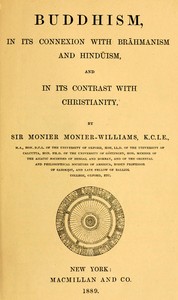
Buddhism, in Its Connexion with Brahmanism and Hinduism, and in Its Contrast with Christianity
Written by Monier Monier-Williams
Chaptra reads alongside you — AI insights, chapter breakdowns and reader discussions for every book. Join free
About this book
Reading guide
Themes, characters and key ideas in Buddhism, in Its Connexion with Brahmanism and Hinduism, and in Its Contrast with Christianity, written by Chaptra AI.
- about 25 hours
- advanced
- scholarly
- analytical
- comparative
Sir Monier Monier-Williams's "Buddhism, in Its Connexion with Brahmanism and Hinduism, and in Its Contrast with Christianity" is a seminal late 19th-century scholarly treatise that meticulously examines the origins, doctrines, and historical development of Buddhism. Drawing from extensive research and personal experience, the author positions Buddhism within the broader framework of Indian religious thought, highlighting its intricate relationships with Brahmanism and Hinduism. The work's central aim is to provide a comprehensive, albeit Christian-centric, comparison of Buddhist philosophy and practices with the tenets of Christianity. Ultimately, it seeks to clarify the often-misunderstood aspects of Buddhism for a Western audience while critically assessing its merits and perceived drawbacks from a distinctly theological viewpoint.
“"It is impossible to understand Buddhism without first comprehending its profound and intricate connection with the ancient Brahmanical systems of India."”
Key themes
- Comparative Religion and Theology
- The central theme of the book is the systematic comparison and contrast of Buddhism with Brahmanism, Hinduism, and most critically, Christianity. Monier-Williams meticulously dissects doctrines, ethical systems, and metaphysical assumptions of each tradition, often highlighting what he perceives as the unique strengths and ultimate truth of Christianity.
- The Origins and Evolution of Buddhism
- Monier-Williams provides a comprehensive historical and philosophical account of Buddhism, tracing its emergence from the religious and social milieu of ancient India. He explores the life of Siddhartha Gautama, the foundational teachings, the development of various schools (Hinayana, Mahayana), and its geographical spread.
- 19th-Century Western Orientalism and Christian Apologetics
- The book serves as a prime example of 19th-century Western scholarship on Eastern religions, characterized by a blend of genuine academic curiosity and an underlying apologetic agenda. Monier-Williams, while scholarly, subtly (and sometimes overtly) positions Christianity as the superior or ultimate truth, evaluating other religions through this lens, reflecting the colonial and theological attitudes of his era.
Worth discussing
How does Monier-Williams's 19th-century Christian perspective shape his interpretation and critique of Buddhism? Is it possible for a scholar to be truly objective when analyzing a religion from an external framework?
Chapter-by-chapter breakdowns, character arcs and the full thematic analysis come with a free account.
Discussions
No one has started one yet
Questions this book opens up
No discussions yet
Be the first to start a discussion about this book!
Sign up to start the discussionReviews
No reviews yet
Be the first to review this book!