
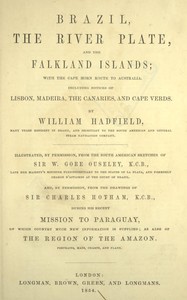
Brazil, the River Plate, and the Falkland Islands: With the Cape Horn route to Australia. Including notices of Lisbon, Madeira, the Canaries, and Cape Verde.
Written by William Hadfield
Chaptra reads alongside you — AI insights, chapter breakdowns and reader discussions for every book. Join free
About this book
Reading guide
Themes, characters and key ideas in Brazil, the River Plate, and the Falkland Islands: With the Cape Horn route to Australia. Including notices of Lisbon, Madeira, the Canaries, and Cape Verde., written by Chaptra AI.
- about 12 hours
- advanced
- informative
- observational
- historical
William Hadfield's 'Brazil, the River Plate, and the Falkland Islands' is a comprehensive 19th-century travelogue detailing an extensive maritime journey from Europe through the Atlantic to South America and onwards via Cape Horn to Australia. The book meticulously records the geography, natural history, socio-economic conditions, and cultural observations of various regions, including Lisbon, Madeira, the Canaries, Cape Verde, Brazil, the River Plate (Argentina and Uruguay), and the Falkland Islands. It serves as both a practical guide for mariners and traders and a vivid historical document reflecting British imperial interests and the spirit of exploration during the era. Hadfield's account offers invaluable insights into the state of these territories and the challenges of long-distance sea travel in the mid-19th century.
“The vastness of the Brazilian interior, yet to be fully charted, promises untold riches to those with the foresight and fortitude to explore its depths.”
Key themes
- Trade and Commerce
- As a work likely penned by a merchant or for a commercially-minded audience, trade and commerce are central. Hadfield meticulously details the products, markets, port facilities, and economic conditions of each region, highlighting opportunities and challenges for international trade. The entire journey can be seen as an investigation into global trade networks.
- Exploration and Discovery
- The overarching theme of the book is the spirit of exploration and the act of discovery, not necessarily of unknown lands, but of charting, documenting, and understanding regions from a European perspective. It highlights the ambition to map the world, understand its resources, and connect its diverse parts through maritime routes.
- Colonialism and Imperialism
- The book implicitly and explicitly explores themes of colonialism and British imperial interests. Hadfield's observations often focus on the economic potential of regions, their strategic value for trade routes (like the Falklands and Cape Horn), and the opportunities for British influence. While not an overt political treatise, it reflects the prevailing attitudes and justifications for European expansion.
Worth discussing
How does Hadfield's account reflect British imperial interests and the economic motivations behind 19th-century exploration?
Chapter-by-chapter breakdowns, character arcs and the full thematic analysis come with a free account.
Discussions
No one has started one yet
Questions this book opens up
No discussions yet
Be the first to start a discussion about this book!
Sign up to start the discussionReviews
No reviews yet
Be the first to review this book!