
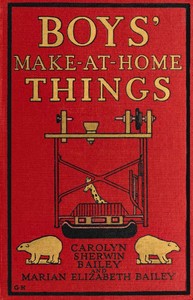
Boys' Make-at-Home Things
Written by Carolyn Sherwin Bailey,Marian Elizabeth Bailey
Chaptra reads alongside you — AI insights, chapter breakdowns and reader discussions for every book. Join free
About this book
Reading guide
Themes, characters and key ideas in Boys' Make-at-Home Things, written by Chaptra AI.
- about 15 hours
- intermediate
- instructive
- encouraging
- practical
Boys' Make-at-Home Things is an early 20th-century instructional guide designed to equip young boys with practical skills in crafting and resourcefulness. Through a series of projects, the book encourages hands-on learning, teaching how to create toys and useful household articles from simple, often repurposed, materials. It champions creativity, self-reliance, and the joy of manual labor, serving as both an entertainment source and an educational tool for developing artistic and practical aptitudes. The book's methodical approach, starting with basic tool-making and progressing to more complex constructions, fosters a sense of accomplishment and ingenuity in its young audience.
“Every boy should know the joy of making things with his own hands.”
Key themes
- Craftsmanship and Manual Skill
- The core theme emphasizing the value of creating things with one's own hands. It promotes the development of fine motor skills, precision, and an understanding of materials and construction, fostering a deep appreciation for the effort and artistry involved in making.
- Resourcefulness and Repurposing
- This theme highlights the ingenuity of using readily available, often discarded, household items to create new and useful objects. It teaches economic sensibility, environmental awareness (by reducing waste), and creative problem-solving by seeing potential in ordinary materials.
- Education Through Doing (Experiential Learning)
- This theme underscores the pedagogical philosophy that true learning comes from direct experience and hands-on engagement. The book implicitly argues that practical application of knowledge leads to deeper understanding and skill acquisition than theoretical instruction alone.
Worth discussing
How does the book reflect the societal expectations and values for boys in the early 20th century?
Chapter-by-chapter breakdowns, character arcs and the full thematic analysis come with a free account.
Discussions
No one has started one yet
Questions this book opens up
No discussions yet
Be the first to start a discussion about this book!
Sign up to start the discussionReviews
No reviews yet
Be the first to review this book!